
Evaluating AI coaching platforms requires moving beyond polished presentations to understand what actually drives manager effectiveness. Here's what to test.
Quick Takeaway: The vendors worth your time are those built on purpose-built coaching expertise, deeply contextual about your people and workflows, proactively engaged rather than reactive, seamlessly integrated into daily tools, and equipped with proper guardrails for sensitive topics. These five criteria directly determine whether managers trust the guidance enough to change their behavior.
In our work helping organizations select and implement AI coaching solutions, we've learned that the difference between a platform that transforms manager effectiveness and one that becomes shelfware often comes down to what you test during the demo. Most vendor presentations follow a predictable script: polished slides, a dashboard walkthrough, and a few predetermined use cases. You leave with a sense of what the platform could do, but little understanding of what it will actually do when your managers face real challenges.
Purpose-built coaching platforms ground their AI in people science and proven leadership frameworks, while generic tools repurpose general AI for workplace use. The difference determines whether managers trust guidance enough to change behavior.
Ask vendors directly: What coaching methodology informs your AI? Which leadership frameworks does it draw from? Look for platforms trained by ICF-certified coaches with proprietary knowledge bases, not just internet content. When ChatGPT compiles the world's information, the result is the lowest common denominator of that knowledge. When it comes to leadership, the devil is in the details: nuance of the individual human dynamics at play in any given situation is what matters.
Request specific examples of how the platform would handle a delegation challenge for a first-time manager versus a senior leader. Evaluate whether the system recognizes that leadership needs differ by role, level, and organizational culture. Test whether advice feels specialized or generic by asking the same scenario twice with different contexts.
Effective AI coaches integrate with your HR systems, performance data, and communication tools to understand individual employees, organizational culture, and team dynamics, eliminating friction that kills adoption.
Ask what data sources the platform accesses: HRIS, performance reviews, 360 feedback, meeting transcripts, calendar patterns. Test whether the AI adapts recommendations based on an employee's communication style, career goals, and past interactions. Demonstrate a scenario twice with different demographics and evaluate whether guidance adjusts appropriately while maintaining consistency.
Confirm whether the platform can be customized with your company's competency frameworks, values, and leadership language. Request analytics showing how personalization correlates with adoption rates. Look for platforms maintaining 85% or higher monthly retention, a signal that managers find the coaching relevant enough to return consistently.
Proactive platforms that deliver feedback after meetings and interactions drive dramatically higher engagement than reactive tools requiring managers to remember to seek help.
Ask how the platform identifies coaching moments without being prompted. Request a walkthrough of how the system would support a manager through a month-long skill development goal. Evaluate whether the platform joins meetings, analyzes communication patterns, or only responds to direct questions.
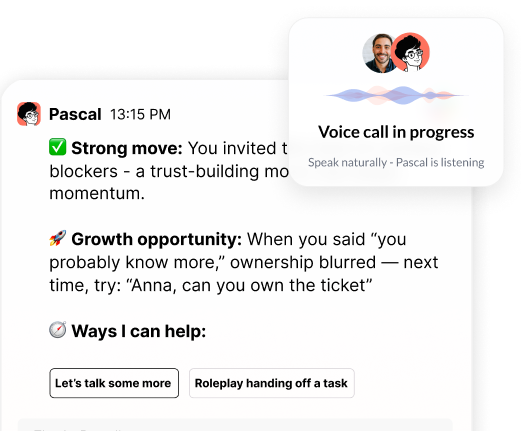
Test engagement metrics: platforms driving sustained adoption typically show 2 or more coaching sessions per week. Confirm whether the system provides regular check-ins, celebrates progress, and adjusts difficulty as skills improve. Pascal maintains 94% monthly retention with an average of 2.3 coaching sessions per week, demonstrating the sustained engagement that proactive engagement creates.
Platforms meeting managers in Slack, Teams, and Zoom eliminate friction and drive adoption. Tools requiring separate logins struggle to move beyond early adopters.
Observe whether the demo requires switching to a separate portal or happens within existing tools. Ask about voice-to-text capabilities for managers who prefer talking through challenges. Confirm integration with your specific communication platforms and calendar systems.
Test how quickly a manager can access coaching from the moment they need it. Evaluate whether setup requires extensive explanation or feels natural within existing workflows. The best solutions meet managers where they already work rather than requiring new tool adoption.
Purpose-built coaching systems recognize when situations require HR escalation and include guardrails that protect organizations while helping managers prepare for difficult conversations.
Present a termination scenario and observe whether the platform provides step-by-step firing scripts or escalates to HR. Ask about moderation systems that detect harassment, discrimination, mental health concerns, or other sensitive triggers. Confirm escalation protocols for medical issues, employee grievances, and legal situations.
Test organization-specific controls: can you customize which topics trigger escalation? Verify that sensitive coaching conversations remain confidential and aren't shared with managers or HR unless the employee chooses to involve them. When a manager asks about firing someone, Pascal explains why HR expertise is essential, recommends connecting with the people team, and continues supporting the manager's preparation for that conversation.
Enterprise-grade platforms implement user-level data isolation, encryption, SOC2 compliance, and explicit commitments that customer data never trains models.
Ask directly: Do you train AI models on customer data? The answer should be no. Confirm whether data is stored at the user level, making cross-user leakage technically impossible. Request SOC2, GDPR, and CCPA compliance documentation.
Ask about data retention policies and your ability to export or delete data upon contract termination. Verify whether employees can view and control what the platform knows about them through transparent settings. Pinnacle has completed its SOC2 examination, reinforcing commitment to data security and privacy for customers and stakeholders through architectural decisions rather than just policies.
Effective platforms track adoption, behavioral change, and business outcomes, not just completion rates or satisfaction scores.
Request customer case studies showing adoption rates, manager effectiveness improvements, and team performance gains. Ask for specific metrics: What percentage of direct reports report improvement in their managers? Strong platforms show 80% or higher. Confirm whether the platform measures leading indicators (session frequency, engagement) and lagging indicators (manager NPS, retention).
Request references from organizations similar to yours who can speak to implementation experience and ROI. Evaluate whether the vendor can connect coaching activity to business outcomes like reduced turnover or faster manager ramp time. Organizations using purpose-built AI coaching report that 83% of direct reports see measurable improvement in their managers, with highly engaged users showing a 20% average lift in Manager Net Promoter Score.
Organizations that complete evaluation in one to two months rather than extended pilots maintain momentum and see better adoption outcomes.
Ask about implementation timeline: How long does setup take? What resources do you need to provide? Confirm whether the vendor offers white-glove onboarding and change management support.
Discuss pilot scope: Can you start with a small group and expand based on results? Verify pricing structure: How does it scale from pilot to full rollout? Establish clear success metrics upfront so you know what success looks like before launch. Research on AI adoption shows that organizations wrapping evaluation in one to two months rather than extended pilots see better adoption outcomes because they maintain momentum with early adopters while building confidence among the broader population.
Ready to see what purpose-built AI coaching looks like in practice? Book a demo to run these evaluation questions with our team and experience how Pascal delivers coaching that managers actually trust and apply. Discover how contextual awareness, proactive engagement, and proper guardrails combine to drive the measurable behavior change that justifies your investment in manager development.

.png)
.webp)
“Thank you for setting the great foundation for my promotion; now I have a plan!"

Curious to see how AI Coaching can 10X the impact and scale of your development initiatives. Book a demo today for: