

Most vendor demos showcase features. The questions below help you evaluate whether a platform will change manager behavior—not just impress in a 30-minute presentation.
• Start with your specific problem (avoiding difficult conversations, inconsistent 1:1s, new leader support gaps) before evaluating features
• Prioritize platforms that integrate with tools managers already use—separate logins kill adoption
• Demand specific evidence: behavior change metrics, not login counts
• Verify guardrails for sensitive topics (harassment, mental health, legal issues) with clear escalation protocols
• Confirm your data stays private and never trains vendor models
Generic advice doesn't change behavior. Managers ignore coaching that doesn't account for their team's goals, your company's culture, or the specific challenges they face.
Ask: "What data sources does your platform integrate with?" Look for specifics: HRIS systems, performance management tools, engagement surveys, communication platforms. Vendors who answer "we can integrate with anything" haven't solved the integration problem.
Ask: "How does the platform learn our leadership competencies and cultural values?" Real personalization requires ingesting your competency frameworks, not just demographic data.
Ask: "Can you show me how the same question gets answered differently for two managers in different contexts?" This reveals whether personalization is real or cosmetic.
Context matters at three levels. At the organizational level, a startup's leadership culture differs from a Fortune 500 company's. At the team level, managing individual contributors requires different skills than leading other managers. At the individual level, a first-time manager needs foundational guidance that would bore a VP with 15 years of experience.
Consider how a platform handles this scenario: A manager asks, "How do I give feedback to an underperforming team member?"
A generic platform offers general frameworks (Situation-Behavior-Impact) or tips about being specific and timely. This advice isn't wrong, but it's not useful.
A contextual platform considers: Is this the team member's first performance issue or part of a pattern? Is the manager new to giving critical feedback? What does the company's performance management process require? Has the manager documented previous conversations?
The coaching would then address the specific situation: "Based on your previous conversations with this team member and your company's performance improvement process, here's how to structure this conversation. Given that you're three weeks from the end of Q2 and this person's project impacts the product launch, here's how to balance urgency with fairness."
Ask vendors to demonstrate this during the demo. Provide a realistic scenario from your organization and see how their platform would coach a manager through it.
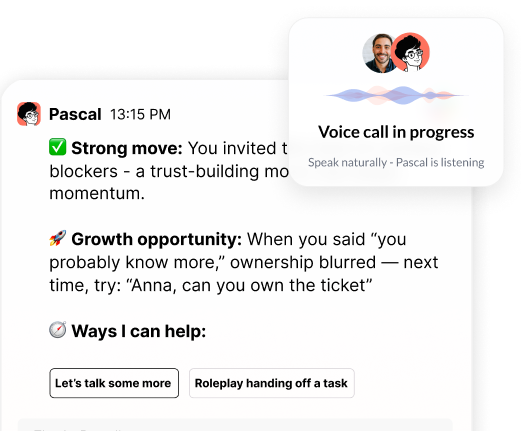
The best coaching happens where work already happens (Slack, Teams, Zoom, calendars), not in a separate platform managers need to remember to visit.
Ask: "Where does coaching happen—in the tools we already use or in a separate interface?" Platforms requiring separate logins see adoption drop after the first month.
Ask: "Does the platform wait for managers to ask for help, or does it surface guidance proactively?" Reactive tools miss the moments that matter most.
Ask: "Can you show me what a manager experiences in their first week?" The onboarding experience predicts whether the tool becomes a habit or gets ignored.
Ask: "What percentage of your customers still use the platform six months after launch?" This number reveals more than any feature list.
For a new behavior to become automatic, it needs a consistent trigger, minimal friction, and immediate value. When coaching lives in a separate platform, managers need to remember to visit it (inconsistent trigger), log in and navigate to the right section (friction), and hope the advice applies to their current situation (delayed value).
When coaching appears in tools managers already use, the triggers are built in. A manager opens Slack to message their team and sees a coaching tip about the 1:1 scheduled in 30 minutes. They finish a meeting and receive immediate feedback about their facilitation.
Compare these experiences:
Separate Platform: Manager has a difficult conversation coming up. They remember the coaching platform exists. They open a new browser tab, navigate to the platform, log in (or reset their password because it's been weeks), search for relevant content, read generic advice, try to apply it to their specific situation, then return to their actual work.
Integrated Platform: Manager has a difficult conversation coming up. The coaching platform notices the meeting on their calendar, recognizes keywords in the meeting title, and sends a message in Slack: "I see you have a performance conversation with Alex in an hour. Based on your previous 1:1s and Alex's recent project challenges, here are three specific approaches to consider."
During the demo, count how many clicks it takes to get coaching. Each additional step reduces adoption probability.
Also ask about mobile experience. Managers often prepare for conversations during commutes or between meetings.
AI coaching needs clear boundaries. Harassment complaints, discrimination concerns, mental health crises, and legal issues require human expertise—not algorithmic responses.
Ask: "How does your platform identify topics that need human intervention?" Look for specific moderation systems, not vague promises about responsible AI.
Ask: "What happens when someone discusses harassment or mental health concerns?" The answer should include immediate escalation protocols and clear handoffs to appropriate resources.
Ask: "Can we customize escalation triggers based on our policies?" One-size-fits-all guardrails don't account for industry regulations or company culture.
Ask: "Who trained the models, not just what models you use?" Platforms trained on general internet data handle edge cases differently than those built with HR professionals and organizational psychologists.
An AI platform that gives poor advice about a harassment complaint doesn't just fail to help—it creates legal liability and causes real harm.
The platform should acknowledge the seriousness, provide immediate resources, and connect the person to appropriate human support. For example: "This situation requires immediate attention from HR. I'm not equipped to provide guidance on harassment complaints. Here's how to contact [specific HR contact] right now."
Ask vendors about their escalation protocols for different scenarios:
Harassment and discrimination: How quickly does the platform escalate? Who gets notified? What resources does the manager receive?
Mental health concerns: If a manager mentions that a team member is showing signs of depression or mentions suicide, what happens? Does the platform distinguish between "my team member seems burned out" (coaching opportunity) and "my team member mentioned self-harm" (immediate crisis intervention)?
Legal and compliance issues: If a manager asks about terminating an employee, does the platform understand the legal implications?
Performance improvement plans: Does the platform recognize when a situation has moved beyond coaching into formal performance management?
The vendor should show you their escalation taxonomy—the specific categories of issues that trigger human intervention, the severity levels, and the corresponding protocols.
Ask about false positives and false negatives. A system that escalates too aggressively creates alert fatigue. A system that misses genuine crises fails at its most important function.
Ask who reviews escalated cases and how quickly. If the answer is "our customer success team reviews flagged conversations within 24 hours," that's not fast enough for a harassment complaint or mental health crisis.
Features don't matter if managers don't change how they lead.
Ask: "What do you measure to prove the platform is working?" Completion rates and login frequency don't predict effectiveness. Look for metrics tied to manager behavior: 1:1 meeting quality, feedback consistency, team performance indicators.
Ask: "Can you share case studies with specific outcomes?" Vague claims about "improved engagement" mean less than concrete examples: "managers increased 1:1 frequency from monthly to weekly" or "direct report satisfaction scores rose 15 points."
Ask: "How do you measure whether managers applied the guidance, not just read it?"
Ask: "What happens if we don't see results?" Understanding the vendor's accountability reveals whether they're confident in their platform or just confident in their sales process.
Organizations using Pascal report that 83% of direct reports see improvement in their managers within 90 days. These outcomes stem from coaching that's proactive, contextual, and embedded in daily work.
The measurement challenge with AI coaching is separating correlation from causation. Managers who actively seek coaching are probably already more engaged and effective than those who don't.
Look for vendors who can demonstrate impact through controlled comparisons. More commonly, vendors should show before-and-after comparisons with appropriate controls. For example: "We compared engagement scores for teams whose managers used the platform versus teams whose managers didn't, controlling for previous engagement levels, team size, department, and manager tenure. Teams with managers using the platform showed 12% higher engagement growth over six months."
Request case studies that include:
The starting point: What was the specific problem? What were the baseline metrics?
The intervention: How was the platform implemented? What percentage of managers used it? How frequently?
The outcomes: What changed? Over what timeframe? How do you know the platform caused the change rather than other factors?
The persistence: Did the improvements last? What happened to metrics six months or a year after implementation?
Ask vendors about negative results too. What have they learned from implementations that didn't work? What conditions predict success versus failure?
Data Breakdown:
• Feature Category: Integration Depth | What to Look For: Native integration with Slack, Teams, calendar systems, HRIS | Red Flags: "We can integrate with anything" without specifics | Questions to Ask: "Show me the actual user experience in Slack/Teams"
• Feature Category: Contextual Personalization | What to Look For: Ingests competency frameworks, performance data, team structure | Red Flags: Generic advice regardless of role or situation | Questions to Ask: "How does coaching differ for a first-time manager vs. a VP?"
• Feature Category: Proactive Coaching | What to Look For: Surfaces guidance before meetings, during key moments | Red Flags: Requires managers to remember to log in | Questions to Ask: "What triggers coaching suggestions?"
• Feature Category: Sensitive Topic Handling | What to Look For: Immediate escalation protocols, human handoff for crises | Red Flags: Vague "responsible AI" promises | Questions to Ask: "Show me what happens if someone mentions harassment"
• Feature Category: Evidence of Impact | What to Look For: Behavior change metrics, controlled studies, 6+ month retention | Red Flags: Login counts, completion rates only | Questions to Ask: "What percentage of customers renew after year one?"
• Feature Category: Data Governance | What to Look For: SOC2 compliance, no training on customer data, individual privacy controls | Red Flags: Unclear data usage policies | Questions to Ask: "Can we see your data processing agreement?"
• Feature Category: Adoption Metrics | What to Look For: 60%+ active usage at 6 months, embedded in workflow | Red Flags: Separate platform requiring new habits | Questions to Ask: "What's your median 6-month adoption rate?"
Enterprise AI coaching requires clarity about what happens to your information.
Ask: "Is our data ever used to train your AI models?" The answer should be no. Platforms that use customer data for model training expose your sensitive information.
Ask: "What compliance certifications do you maintain?" For regulated industries, ask about data retention options and how the platform handles protected information.
Ask: "Can we see your data processing agreement?" Transparency here reveals whether the vendor treats data governance as a priority or an afterthought.
Ask: "How do you balance individual privacy with organizational insights?" Individual-level monitoring erodes trust. Anonymous aggregated insights surface trends without surveillance.
Pascal is SOC2 compliant and never uses customer data to train models. Managers control when Pascal observes meetings and can pause it at any time. Personal feedback stays private—it's never exposed to HR or leadership without the manager's consent.
Data governance in AI coaching involves multiple stakeholders with different needs. Managers need privacy to ask questions without fear that HR is monitoring their every interaction. HR needs aggregate insights to understand where managers need support. The organization needs assurance that sensitive information isn't being exposed or misused.
Ask vendors how they navigate these tensions:
Data minimization: What data does the platform actually need versus what it could theoretically collect?
Purpose limitation: Is data collected for coaching used only for coaching, or does it feed other systems?
Individual control: Can managers see what data the platform has collected about them? Can they delete it?
Aggregate reporting: When the platform provides organizational insights, how is individual privacy protected?
Data retention: How long does the platform store conversation data? Can you set custom retention policies?
Before evaluating features, clarify what you're trying to fix. Are managers avoiding difficult conversations? Do new leaders lack support between training sessions? Are 1:1s happening but not driving performance?
The platform that solves your specific problem matters more than the one with the most capabilities.
Consider the difference between surface-level symptoms and root causes. If your employee engagement scores show that "communication with managers" is a weak point, that's a symptom. The root cause might be that managers don't know how to structure effective 1:1s, or they're uncomfortable giving developmental feedback, or they're overwhelmed and deprioritizing people management.
One mid-sized technology company initially thought they needed a platform to increase 1:1 frequency. Their calendar data showed managers were meeting with direct reports regularly, but engagement scores weren't improving. The real problem wasn't meeting frequency—it was meeting quality. Managers were using 1:1s for status updates instead of development conversations.
Take time to analyze your data before the demo. Review your engagement survey results, performance review completion rates, promotion readiness assessments, and exit interview themes. This analysis helps you ask vendors specific questions about how their platform addresses your actual challenges.
Ready to see how Pascal addresses these questions? Schedule a demo to experience proactive, contextual coaching that meets managers where they work.
Header photo by Vitaly Gariev on Unsplash

.png)
.webp)
“Thank you for setting the great foundation for my promotion; now I have a plan!"

Curious to see how AI Coaching can 10X the impact and scale of your development initiatives. Book a demo today for: