
Real-world AI coaching implementations are proving that contextual guidance drives measurable improvements in manager decision-making and team engagement. Organizations like Verkada, Bercatta, and leading tech companies report that managers using purpose-built AI coaching show 83% observable improvement from direct reports, with 20% average lifts in Manager Net Promoter Score among highly engaged users. These outcomes stem not from generic AI tools, but from platforms that understand organizational context, integrate into daily workflows, and provide proactive support at the moments managers need it most.
Quick Takeaway: Real implementations show AI coaching delivers measurable ROI through three mechanisms: it reduces time spent on routine coaching questions, improves the quality of manager-to-employee interactions, and accelerates behavior change because guidance arrives in the flow of work rather than days later. The organizations seeing the strongest outcomes prioritize contextual awareness, proactive engagement, and workflow integration over feature count or vendor reputation.
Verkada made Pascal mandatory for engineering managers seeking promotion, embedding AI coaching data directly into leadership advancement decisions. This isn't symbolic adoption. It's structural integration that forces rigor into how the company assesses whether managers are ready for greater responsibility.
New managers work with Pascal for three months before any promotion evaluation begins. During this period, the platform observes actual team interactions, tracks feedback quality, and measures whether managers are delegating effectively and creating psychological safety. Pre- and post-coaching surveys from direct reports provide the human validation layer. When promotion time arrives, Verkada combines objective AI coaching data with 360 feedback to make advancement decisions grounded in evidence rather than intuition.
The result is higher confidence in promotion outcomes. Managers who haven't demonstrated improvement through consistent Pascal engagement don't advance. Those who show measurable behavior change in feedback frequency, delegation clarity, and one-on-one effectiveness move forward knowing they've proven readiness. This reduces costly mis-hires into management and accelerates high-potential individual contributors into leadership roles where they're more likely to succeed.
At this Series D hardware company, Pascal became a requirement for engineering manager advancement, providing structured data on leadership capability that replaces guesswork in advancement decisions. Rather than relying on senior leader impressions or informal feedback, Bercatta created an objective pathway: demonstrate coaching competency through consistent AI coaching engagement, and you become eligible for promotion.
Managers complete specific coaching milestones with Pascal before promotion consideration, tracking whether they've improved delegation, created psychological safety, and maintained feedback consistency. Direct reports provide feedback on observed behavior change, which feeds directly into promotion assessment. This dual-layer approach—AI-tracked behavior plus human validation—creates accountability that traditional promotion processes lack.
The business impact shows up in retention and performance. When managers know advancement depends on demonstrable leadership improvement, they engage more seriously with coaching. When their teams see coaching translate to better management, engagement improves. The structural connection between AI coaching engagement and career progression turns coaching from optional self-improvement into a competitive advantage for advancement.
A 50-person rollout of AI coaching generated 150 hours of time savings in the first month through automated feedback collection and just-in-time coaching that reduced escalations to HR. This isn't marginal efficiency gain. It's substantial reclamation of HR and manager time that redirects to strategic work.
Managers use Pascal to prepare for difficult conversations instead of scheduling lengthy HRBP coaching sessions. Performance review preparation time drops from hours to minutes with AI-synthesized performance data. Routine management questions get answered in-flow rather than through HR tickets that create bottlenecks. Time reclaimed by HR teams redirects to succession planning, organizational design, and culture initiatives that require human expertise.
The quality improvement compounds the time savings. When managers prepare for feedback conversations with AI coaching, they're more specific and fair. When they get real-time meeting feedback, they adjust communication patterns in real time. When they have structured guidance for difficult situations, they handle them more effectively. The 150 hours saved represents not just efficiency but quality improvement that shows up in direct report engagement scores and retention metrics.
Experian's AI coaching pilot achieved immediate adoption and sustained engagement because the tool met managers in Slack, not in a separate system. Within the first hour of launch, 100% of pilot participants engaged with the AI coach. Net Promoter Score reached 85 initially, climbing to 96 in expanded beta. Every participant said they would continue using the coach.
High engagement stemmed from workflow integration and immediate value demonstration. Managers didn't need to remember to open another application or navigate unfamiliar interfaces. The AI coach appeared in the tools they already used dozens of times daily. More importantly, the first interaction delivered visible value. Managers received specific feedback on their communication patterns or guidance tailored to their actual team dynamics, not generic advice that could apply to anyone.
This adoption pattern—immediate, sustained, and near-universal—reveals something fundamental about what makes AI coaching effective at scale. It's not sophistication of the underlying model. It's whether the tool removes friction and delivers contextual relevance from the first interaction. When both conditions are met, adoption becomes self-reinforcing because managers experience value immediately.
Recent research shows that 83% of direct reports report observable improvement in their manager's effectiveness when managers use AI coaching consistently. This isn't perception-based satisfaction. It's observable behavior change that colleagues notice and experience directly.
Organizations report 20% average lift in Manager Net Promoter Score among highly engaged users. Improvements show up in specific behaviors: more frequent feedback, clearer delegation, more developmental one-on-ones. These aren't abstract improvements. They're the exact behaviors that drive team engagement and performance.
94% monthly retention indicates managers maintain consistent engagement because coaching feels relevant. Average of 2.3 coaching sessions per week suggests habit formation rather than sporadic tool use. This sustained engagement matters because behavior change requires practice and reinforcement. One-time coaching events don't create lasting improvement. Consistent, contextual guidance does.
HubSpot introduced AI tools within the first two days of new hire onboarding and created visible, social proof through weekly demonstrations of AI use cases. This wasn't passive availability. It was active cultural integration that normalized AI as part of how work gets done.
98% of employees used AI tools on the job by mid-2025, with 84% feeling comfortable using AI in their daily work. The company normalized AI through cultural messaging, not mandates. Weekly "MondAI Minute" sessions where employees demo AI wins created peer learning and reduced resistance. When colleagues see practical examples of how AI solved real problems, skepticism transforms into curiosity.
This cultural approach matters because adoption isn't primarily a technology problem. It's a trust and relevance problem. When employees see leadership using AI visibly, when peers share concrete examples of value, when the organization positions AI as a capability enabler rather than a job threat, adoption follows naturally.
Zapier embedded AI fluency directly into hiring, onboarding, and performance reviews, making AI coaching part of how people work rather than an optional tool. Candidates are assessed on a four-level AI fluency rubric during interviews. New hires immediately learn to "build the robot," automating repetitive tasks. Performance reviews fold AI usage into existing leadership behaviors, not as separate expectations.
This structural integration creates accountability and capability development simultaneously. When AI fluency becomes a hiring criterion, you attract people predisposed to experimentation. When onboarding includes immediate hands-on AI practice, new employees develop confidence quickly. When performance reviews include AI usage, managers prioritize learning because advancement depends on demonstrated capability.
The result is 75% of knowledge workers adopt AI when supported by structure and clear expectations. This number matters because it shows adoption isn't about technology sophistication or feature richness. It's about organizational design that makes capability development expected, supported, and rewarded.
Managing 400,000+ employees globally, Marriott embeds AI coaching in mobile-first learning hubs that deliver personalized micro-lessons to frontline associates and strategic fluency training to leaders. This is coaching at true organizational scale, where one-size-fits-all approaches fail immediately.
Associates access AI-curated career pathways on mobile devices, with coaching happening in moments of readiness rather than scheduled training sessions. Coaching reaches people where they work, not where HR hopes they'll visit. Senior leaders receive guidance on when to automate, when to keep humans in the loop, and how to design for enterprise-wide impact. Proactive delivery ensures coaching reaches people at the right moment with the right guidance.
The mobile-first, proactive model matters because frontline workers have fragmented time and competing demands. Traditional learning platforms that require desktop access and scheduled participation never reach them. AI coaching that meets them on devices they already carry, in moments they have available, finally makes development accessible to the entire workforce.
Across these implementations, three patterns emerge that explain why AI coaching improves decision quality and engagement.
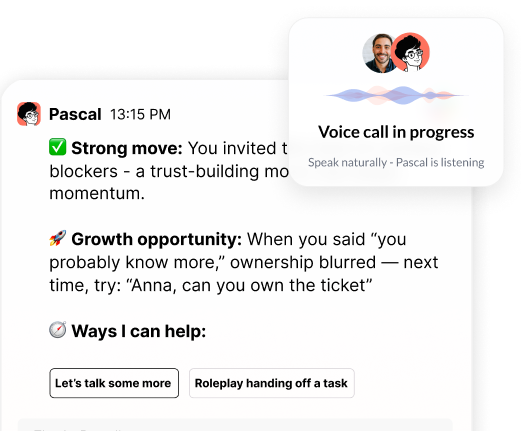
First, managers make better decisions when they have immediate, contextual guidance tailored to their specific team and situation. Generic advice gets ignored. Personalized coaching informed by performance data and team dynamics gets applied. When a manager can ask for specific guidance on delegating to Anna, considering her communication style and career goals, the advice is actionable in ways that generic delegation frameworks never are.
Second, engagement drives impact. Organizations achieving 80%+ weekly active users see measurable behavior change because consistent coaching creates habit loops. One-time training events don't. Managers who engage with AI coaching 2-3 times weekly develop new patterns through repetition and reinforcement. Those who use it sporadically see minimal change.
Third, workflow integration matters more than sophistication. The most advanced AI coach fails if it requires switching tools. Pascal's integration into Slack and Teams removes friction that kills adoption in traditional learning platforms. When coaching appears in the tools managers already use, engagement becomes natural rather than requiring willpower to remember another system.
These patterns hold across organization size, industry, and geography. Whether managing 50 people or 400,000, whether in hardware or software, whether distributed or co-located, the organizations seeing strongest outcomes prioritize contextual awareness, proactive engagement, and workflow integration. Those are the factors that determine whether AI coaching becomes transformative or decorative.
Book a demo to explore how Pascal delivers real-time, personalized guidance that managers trust and apply, grounded in your company's culture and actual team dynamics. See how other organizations are using AI coaching to accelerate manager effectiveness and prove ROI through measurable adoption and behavior change.

.png)
.webp)
“Thank you for setting the great foundation for my promotion; now I have a plan!"

Curious to see how AI Coaching can 10X the impact and scale of your development initiatives. Book a demo today for: