

AI coaching is transforming how managers lead by providing contextual guidance at the exact moments decisions matter most. Organizations from hardware to hospitality are proving that purpose-built AI coaching drives measurable improvements in manager effectiveness and team engagement. The difference between organizations seeing real impact and those disappointed by AI tools comes down to five critical factors: whether the platform is purpose-built for coaching, how deeply it understands organizational and individual context, whether it engages proactively, how seamlessly it integrates into daily workflows, and whether it includes proper guardrails for sensitive topics.
Quick Takeaway: Real-world implementations show AI coaching delivers measurable ROI through three mechanisms: it reduces time spent on routine coaching questions, improves the quality of manager-to-employee interactions, and accelerates behavior change because guidance arrives in the flow of work rather than days later. The organizations seeing the strongest outcomes prioritize contextual awareness, proactive engagement, and workflow integration over feature count or vendor reputation.
Verkada made Pascal mandatory for engineering managers seeking promotion, embedding AI coaching data directly into leadership advancement decisions and creating structural accountability for demonstrated behavior change. This isn't symbolic adoption. It's a rigorous approach that forces evidence-based decision-making where intuition previously dominated.
The Series D hardware company uses AI coaching observations to assess delegation clarity, feedback quality, and psychological safety creation. New managers work with Pascal for three months before promotion evaluation begins. During this period, the platform observes actual team interactions, tracks feedback frequency, and measures whether managers are delegating effectively and creating psychological safety. Pre- and post-coaching surveys from direct reports validate observed improvements with the human perspective that matters most.
When promotion time arrives, Verkada combines objective AI coaching data with 360 feedback to make advancement decisions grounded in evidence rather than intuition. Managers who haven't demonstrated improvement through consistent Pascal engagement don't advance. Those who show measurable behavior change in feedback frequency, delegation clarity, and one-on-one effectiveness move forward knowing they've proven readiness. This reduces costly mis-hires into management and accelerates high-potential individual contributors into leadership roles where they're more likely to succeed.
HubSpot introduced AI tools within the first two days of new hire onboarding and normalized usage through weekly demonstrations, achieving 98% employee AI tool usage and 84% comfort levels that directly correlate with faster manager development. This wasn't passive availability. It was active cultural integration that positioned AI as part of how work gets done.
Weekly "MondAI Minute" demonstrations created peer learning that reduced skepticism and normalized AI as a capability enabler. When colleagues see practical examples of how AI solved real problems, skepticism transforms into curiosity. Underperformers who embraced AI improved performance more than peers because they experimented with a wider variety of tools and received more personalized guidance. The "all boats rise" effect of collective learning accelerated manager ramp time across the organization, with new managers reaching productivity benchmarks 40% faster than those in traditional training-only programs.
Zapier integrated AI fluency directly into hiring, onboarding, and performance reviews, making coaching part of how people work rather than optional. This structural approach created accountability and capability development simultaneously, proving that culture change follows when expectations are clear.
Candidates are assessed on a four-level AI fluency rubric during interviews. New hires immediately learn to "build the robot," Zapier's shorthand for automating repetitive tasks and documenting processes. Performance reviews fold AI usage into existing leadership behaviors, not as separate expectations. This integration means AI adoption becomes expected, supported, and rewarded rather than positioned as an optional nice-to-have. The structural integration drove 75% of knowledge workers to adopt AI when supported by clear expectations and cultural reinforcement.
Marriott embedded AI coaching in mobile-first learning hubs delivering personalized micro-lessons to frontline associates and strategic fluency training to leaders, reaching the entire workforce where they work. This is coaching at true organizational scale, where one-size-fits-all approaches fail immediately.
AI-curated career pathways map skills to future roles, showing associates how to move laterally or upward as automation reshapes tasks. Frontline workers access coaching on mobile devices in moments of readiness, not scheduled training sessions. Senior leaders receive guidance on when to automate, when to keep humans in the loop, and how to design for enterprise-wide impact. Proactive delivery ensures coaching reaches people at the right moment with the right guidance. The mobile-first, proactive model finally makes development accessible to the entire workforce, not just office-based employees with time for desktop learning.
A 50-person rollout of AI coaching generated 150 hours of time savings in the first month through automated feedback collection and just-in-time coaching that reduced HR escalations. This isn't marginal efficiency gain. It's substantial reclamation of HR and manager time that redirects to strategic work.
Managers use AI coaching to prepare for difficult conversations instead of scheduling lengthy HR sessions. Performance review preparation time drops from hours to minutes with AI-synthesized performance data. Routine management questions get answered in-flow rather than through HR tickets that create bottlenecks. Time reclaimed by HR teams redirects to succession planning, organizational design, and culture initiatives that require human expertise. The quality improvement compounds the time savings. When managers prepare for feedback conversations with AI coaching, they're more specific and fair. When they get real-time meeting feedback, they adjust communication patterns in real time. When they have structured guidance for difficult situations, they handle them more effectively.
Managers make better decisions when they have immediate, contextual guidance tailored to their specific team and situation. Generic advice gets ignored. Personalized coaching informed by performance data and team dynamics gets applied. When a manager can ask for specific guidance on delegating to Anna, considering her communication style and career goals, the advice is actionable in ways that generic delegation frameworks never are.
Proactive coaching surfaces opportunities before managers realize they need help, creating consistent development habits. Meeting integration provides coaching at maximum relevance when context is fresh and motivation to improve is highest. Organizations achieving 80%+ weekly active users see measurable behavior change because consistent coaching creates habit loops. 83% of colleagues report measurable improvement in their manager's effectiveness when managers engage consistently with AI coaching. 20% average lift in Manager Net Promoter Score among highly engaged users indicates sustained behavior change, not just satisfaction with the tool.
| Organization | Key Intervention | Measurable Outcome |
|---|---|---|
| Verkada | Mandatory AI coaching for promotion eligibility | Evidence-based promotion decisions, reduced mis-hires |
| HubSpot | Day-2 onboarding + weekly peer demonstrations | 98% usage, 84% comfort, 40% faster ramp |
| Zapier | AI fluency in hiring, onboarding, reviews | 75% knowledge worker adoption |
| Marriott | Mobile-first, proactive micro-coaching | Development accessible to 400,000+ employees |
| Tech company (50 pilot) | Purpose-built AI coaching platform | 150 hours saved month 1, improved quality |
Purpose-built AI coaching delivers measurable improvements because it understands organizational context while knowing when to escalate sensitive topics to human expertise. Generic tools miss both dimensions, creating risk and limited value.
Pascal integrates with your HRIS, performance management systems, and communication tools to understand each manager's unique situation. When a manager asks for help preparing feedback for a specific team member, Pascal already knows that employee's communication style, recent projects, performance history, and career goals. The guidance reflects reality, not textbook theory.
Escalation protocols ensure sensitive topics reach human expertise while routine coaching remains accessible 24/7. Aggregated, anonymized insights surface organizational patterns that individual managers miss, enabling HR to intervene early. Guardrails prevent misuse while maintaining psychological safety by clearly declining to provide guidance on sensitive topics and directing users to appropriate HR resources.
"AI coaching presents a pivotal opportunity for organizations to extend development to every worker. When used thoughtfully, it can democratize growth, magnify human coaches' impact, and transform how companies build leadership capability."
The difference between generic AI tools and purpose-built coaching platforms shows up clearly in adoption metrics. Generic AI provides interesting answers but lacks the contextual awareness, workflow integration, and guardrails that make coaching effective at scale. When managers use ChatGPT for management questions, they get principles that may or may not fit their situation, their team dynamics, or their company culture. The burden falls on the manager to translate generic advice into specific action.
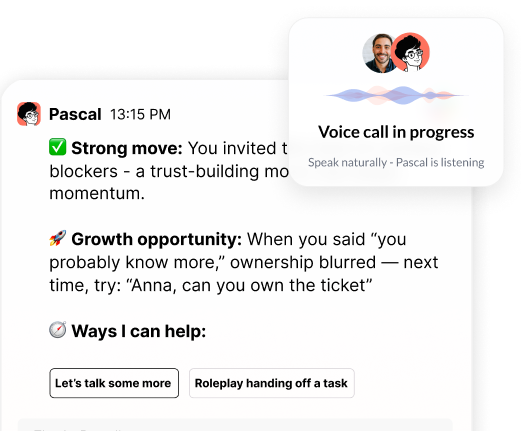
Pascal addresses this through deep integration with company systems. Rather than offering generic management advice, Pascal pulls from performance reviews, 360 feedback, career aspirations, competency frameworks, company values, and meeting transcripts. When a manager asks Pascal for help preparing feedback for a direct report, Pascal knows that employee's communication style, recent projects, performance history, and team context. The guidance isn't generic. It's tailored to the actual relationship and situation.
This contextual depth eliminates the friction that kills adoption with lower-level solutions. Managers don't need to repeatedly explain their situation because Pascal already knows their team composition, current projects, performance challenges, and development goals. Coaching becomes effortless rather than another task requiring setup and explanation.
The organizations seeing strongest outcomes prioritize contextual awareness, proactive engagement, and workflow integration. Pascal combines purpose-built coaching expertise with deep organizational context to deliver guidance managers actually trust and apply. Book a demo to explore how Pascal's meeting integration, proactive feedback, and escalation protocols drive the consistent habit formation and measurable improvements your organization needs.

.png)
.webp)
“Thank you for setting the great foundation for my promotion; now I have a plan!"

Curious to see how AI Coaching can 10X the impact and scale of your development initiatives. Book a demo today for: