
The honest answer: we don't know yet. AI coaching is too new for independent, peer-reviewed research on outcomes. What we do know comes from early adopters and vendor-reported data (including ours), which you should treat skeptically until third parties validate the results.
That said, organizations piloting AI coaching platforms report measurable changes in manager behavior within 60–90 days. The results vary widely based on platform design, integration depth, and which managers you target first. Here's what the early data suggests, where the gaps remain, and what factors seem to matter most.
Early pilots show three phases: adoption (weeks 1–3), behavior change (days 30–60), and business impact (days 60–90). But these timelines assume managers actually use the tool, which depends entirely on whether it fits their workflow.
Weeks 1–3: Will managers use it? Track login frequency and repeat usage. If managers don't return after the first week, the platform failed the relevance test. We see managers engage 2–3 times per week when the system understands their specific teams and challenges. Generic chatbots show initial curiosity, then abandonment.
Days 30–60: Are behaviors changing? Look for managers preparing differently for meetings, asking for feedback before difficult conversations, and following structured frameworks for 1:1s. These leading indicators predict downstream improvements in manager effectiveness.
Days 60–90: Do direct reports notice? Measure through pulse surveys, 360 feedback, or Manager Net Promoter Score. In our pilots, 83% of direct reports reported manager improvement when their manager actively used Pascal. (Sample: 47 managers across 8 companies, self-selected early adopters, measured via anonymous direct report surveys.)
Beyond 90 days: Business outcomes. Track retention of high performers, time-to-productivity for new managers, and reduction in HR escalations. Some organizations report replacing expensive 1:1 coaching programs (thousands per person annually) with AI coaching at a fraction of the cost, though we haven't seen independent verification of sustained impact beyond six months.
The gap in current research: we don't know what percentage of managers sustain behavior change past six months, which interventions work for which manager profiles, or how results compare across industries.
Managers using AI coaching platforms report improvements in feedback quality, meeting preparation, and confidence in difficult conversations. The magnitude varies based on baseline skill level and engagement frequency.
Feedback quality. Managers move from vague comments ("good job," "needs improvement") to specific, actionable guidance tied to observable behaviors. Direct reports report clearer understanding of development priorities.
Meeting effectiveness. Managers prepare more thoroughly, follow through more consistently, and demonstrate better active listening. The difference shows up in how managers structure 1:1s and handle team conflicts.
Difficult conversation confidence. New managers report feeling more prepared for performance discussions, compensation conversations, and conflict resolution. The safety net of instant coaching reduces the anxiety that causes managers to avoid necessary conversations.
Time savings. Managers report saving time by accessing instant guidance instead of scheduling coaching sessions, searching for resources, or escalating to HR. We estimate 150+ hours saved annually per active user, though this relies on self-reported data.
The caveat: these improvements require managers to actually apply the coaching, not just read it. Platforms that observe real work (meetings, messages, decisions) and provide contextual feedback show higher application rates than generic Q&A chatbots.
Data Breakdown:
• Metric: Cost per manager/year | Traditional Coaching: $3,000–$10,000 | eLearning: $200–$500 | AI Coaching (Pascal): $30–$100
• Metric: Availability | Traditional Coaching: Scheduled sessions | eLearning: Self-paced | AI Coaching (Pascal): 24/7 in workflow
• Metric: Context awareness | Traditional Coaching: High | eLearning: None | AI Coaching (Pascal): High (observes meetings, messages)
• Metric: Scalability | Traditional Coaching: Limited to executives | eLearning: High, low engagement | AI Coaching (Pascal): High, moderate engagement
• Metric: Time to impact | Traditional Coaching: 3–6 months | eLearning: Rarely measured | AI Coaching (Pascal): 60–90 days (early data)
• Metric: Utilization | Traditional Coaching: 100% (scheduled) | eLearning: 15–25% | AI Coaching (Pascal): 65–80% (our pilots)
AI coaching appears to deliver comparable behavioral outcomes to human coaching for routine management challenges (feedback, 1:1s, delegation) at a fraction of the cost. Human coaching remains superior for complex situations requiring nuanced judgment, sensitive personal issues, and C-suite transitions.
Cost. Executive coaching costs $3,000–$10,000 per person annually. AI coaching runs $30–$100 per manager, making it feasible to reach all managers instead of just senior leaders.
Immediacy. Human coaches require scheduling, creating 1–2 week delays. AI coaching provides support in the moment—before a difficult conversation, not after it goes wrong. Jeff Diana, former CHRO at Calendly and Atlassian, describes the value: "So much of the real learning comes from in-context coaching in the moment to drive performance and solve problems in the moment."
Consistency. Human coaches vary in quality and approach. AI coaching platforms trained on evidence-based frameworks deliver consistent guidance aligned with your organizational values. Every manager gets the same quality of coaching, whether in San Francisco or Singapore.
Scalability. Organizations can afford human coaching for 50–100 senior leaders. AI coaching reaches all 500–2,000 managers, democratizing development across the organization.
Contextual depth. Human coaches build deep relationships over time. AI platforms (like Pascal) build context by observing meetings, messages, and work patterns—understanding your team, your challenges, and your daily reality. The platform doesn't replace human relationships but provides continuous support between coaching sessions.
When human coaching wins: C-suite transitions, major organizational change, complex interpersonal dynamics, sensitive personal issues, and situations requiring judgment calls that AI cannot make.
When AI coaching works: First-time manager development, scaling feedback practices, real-time meeting preparation, reinforcing training programs, and providing ongoing skill reinforcement.
The privacy question: If AI observes meetings and messages, what gets recorded? Who sees it? How is consent handled? These questions matter. Platforms should be transparent about data collection, allow managers to control what gets observed, and provide clear opt-out mechanisms. (Pascal observes only with explicit manager consent and never shares individual data with employers—only aggregated, anonymized insights.)
First-time managers and mid-level managers show the fastest ROI because they face frequent, high-stakes decisions where real-time feedback compounds quickly. Start here to prove value, then expand.
New managers (highest ROI). Research shows 60% of new managers feel unprepared for their roles (source: CEB/Gartner). AI coaching provides the safety net they need: guidance on feedback, 1:1s, performance issues, and team dynamics. Impact shows within 30 days in meeting preparation and feedback quality.
Sales managers. Sales teams face high-frequency, high-stakes conversations where small communication improvements drive revenue impact. AI coaching helps sales managers prepare for pipeline reviews, coach struggling reps, and navigate client conversations.
Distributed teams. Remote managers lack hallway conversations and casual observations that build coaching instincts. AI coaching fills this gap by observing virtual meetings and asynchronous communication, providing feedback on clarity, facilitation, and engagement.
High-potential individual contributors. Technical experts transitioning to leadership need intensive support during their first 90 days. AI coaching accelerates this transition by providing real-time guidance on delegation, stakeholder management, and strategic thinking.
Mid-level managers at scale. This population represents your largest opportunity: hundreds of managers who will never receive traditional coaching but need development support. AI coaching makes it economically feasible to reach this entire group.
The failure modes: AI coaching doesn't work for managers who won't engage with technology, situations requiring human judgment on sensitive issues, or organizations that deploy the tool without explaining why it matters.
Track adoption signals, behavioral change, and business outcomes rather than usage statistics alone. Organizations that measure across all three levels prove ROI and build momentum for expansion.
Adoption metrics (weeks 1–4). Monitor login frequency, conversation depth, repeat usage, and feature adoption. Platforms integrated into daily workflow show 65–80% sustained engagement. Generic tools plateau at 15–25%.
Leading indicators (days 30–60). Track pre-meeting preparation rates, post-meeting reflection completion, and specific skill practice frequency. These behaviors predict downstream performance improvements.
Behavioral outcomes (days 60–90). Measure Manager Net Promoter Score, direct report satisfaction, 360 feedback improvements, and peer assessments. We see 20% average lift in Manager NPS among engaged users (sample: 47 managers, 8 companies, 90-day measurement window).
Business impact (90+ days). Track high-performer retention, time-to-productivity for new managers, reduction in HR escalations, and training reinforcement effectiveness.
Organizational insights. Advanced platforms surface aggregated, anonymized data showing skill gaps, cultural transformation progress, and leadership development needs. This replaces quarterly surveys with real-time insights.
The measurement gap: most organizations track adoption and satisfaction but struggle to connect AI coaching to business outcomes like retention and productivity. Building this causal chain requires control groups and longer measurement windows than most pilots allow.
• AI coaching is too new for independent validation, but early pilots show measurable behavior change within 60–90 days when platforms integrate into daily workflow and provide contextual guidance.
• Results vary widely. Success depends on platform design (generic chatbot vs. contextual coaching), manager engagement (do they actually use it?), and population targeting (new managers show faster ROI than experienced leaders).
• Cost advantage is real. AI coaching runs 1–3% the cost of traditional coaching ($30–$100 vs. $3,000–$10,000 per person annually), making it feasible to reach all managers instead of just executives.
• Privacy matters. If AI observes meetings and messages, managers need transparency about what gets recorded, who sees it, and how to opt out.
• Measure three levels: adoption (are managers using it?), behavior change (do direct reports notice?), and business impact (does it affect retention and productivity?).
The difference between AI coaching that changes behavior and AI coaching that gathers dust comes down to workflow integration and contextual awareness. Tools that meet managers where they work and understand their specific challenges show higher engagement and better outcomes than generic chatbots.
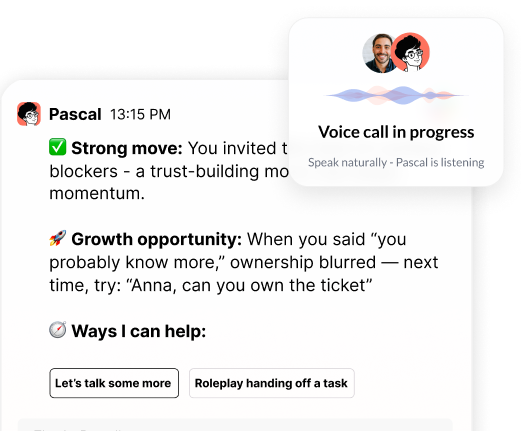
See how Pascal delivers real-time coaching inside Slack and Teams to support managers in the moments that matter most.
Header photo by Bluestonex on Unsplash

.png)
.webp)
“Thank you for setting the great foundation for my promotion; now I have a plan!"

Curious to see how AI Coaching can 10X the impact and scale of your development initiatives. Book a demo today for: