

AI coaching delivers results in three phases: adoption (weeks 1–4), behavior change (weeks 5–12), and business impact (months 4–6). The timeline matters more than the technology. Organizations that track the right metrics at each phase prove ROI and sustain executive support through renewal cycles.
The executive team approved the budget. IT completed the integration. Employees received their login credentials. Now comes the question that determines whether your AI coaching investment survives its first renewal: what specific outcomes should you expect, and when?
Success in the first 90 days shows up in adoption patterns, not business outcomes. By month six, you should see improvements in manager effectiveness, team performance, and retention. Organizations that prove ROI understand this timeline and track the right indicators at each phase.
Track adoption patterns, not business outcomes, in the first 90 days. The difference between success and failure shows up in the first month. Focus on three indicators: weekly active usage among your target population, average sessions per user, and time-to-first-value (days until managers apply coaching in real situations).
Weeks 1–4: Adoption Phase
Your target: 50%+ of managers use the tool at least once. Managers build trust through small wins—preparing for 1:1s, handling difficult conversations, addressing performance issues.
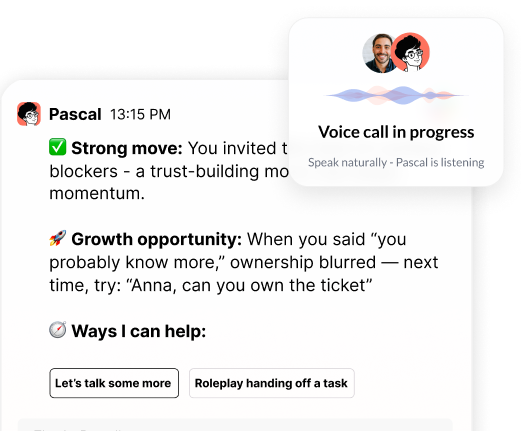
Workflow integration matters. AI coaching that lives in Slack, Teams, or meeting tools eliminates the "blank screen" problem that kills standalone platforms. According to Careertrainer.ai research, AI-powered coaching platforms show 42% higher engagement than traditional methods when they meet managers where work happens.
Weeks 5–8: Habit Formation
Target: 60–75% weekly active usage among your manager population. Managers begin using AI coaching before the difficult conversation, not after it goes wrong. Early behavior changes become visible to direct reports.
Your HRBP team can focus on complex situations requiring human judgment while the AI coach handles routine questions: "How do I prepare for this performance conversation?" and "What's the best way to delegate this project?"
Weeks 9–12: Early Behavior Change
Target: Direct reports notice differences in manager communication. Feedback becomes more specific, timely, and actionable. Managers handle sensitive conversations with greater confidence. Performance review quality increases.
Melinda Wolfe, former CHRO at Bloomberg, Pearson, and GLG, explains the timing: "Managers rarely need help in a workshop—they need it when preparing for a tough 1:1 or in the middle of a team conflict." AI coaching delivers support at those moments, which is why behavior change shows up faster than traditional training programs.
After six months, AI coaching drives improvements in manager effectiveness, team performance, and retention. These outcomes translate to reduced turnover and higher team productivity.
Manager Effectiveness Metrics (Months 4–6)
Managers handle performance conversations, delegation, and conflict resolution with greater skill. Escalations to HR for routine management issues decrease. According to Gartner research, 87% of organizations plan to increase AI investment in learning and development by 2025.
Team Performance Indicators
Improved 1:1 quality shows up in direct report feedback. Team conflicts resolve faster. Performance reviews become more specific and actionable, leading to clearer development paths.
The compound effect matters. When managers improve feedback quality, delegation skills, and conflict resolution simultaneously, team performance improves faster than any single intervention could deliver.
Retention and Development
Reduced regrettable attrition among high performers delivers the clearest ROI. New managers reach proficiency faster, reducing the cost of leadership transitions. Internal promotion rates increase as managers develop leadership capabilities.
Cost comparison: AI coaching delivers results at a fraction of traditional coaching costs while reaching your entire manager population, not just executives.
AI coaching delivers continuous support at scale. Traditional methods provide periodic, high-touch interventions for select populations. The most effective approach combines both: AI coaching handles daily guidance and skill reinforcement, while human coaches address complex situations requiring nuanced judgment.
Data Breakdown:
• Approach: Executive Coaching | Cost per Manager: $5,000–$15,000/year | Time to Impact: 3–6 months | Scalability: Low (executives only)
• Approach: Traditional Training | Cost per Manager: $500–$2,000/year | Time to Impact: 6–12 months | Scalability: Medium
• Approach: LMS Platforms | Cost per Manager: $50–$200/year | Time to Impact: Rarely measurable | Scalability: High (but unused)
• Approach: AI Coaching | Cost per Manager: $100–$300/year | Time to Impact: 1–6 months | Scalability: High
Traditional Coaching Strengths
Deep, personalized relationship building works for complex career transitions and executive presence. Sensitive situations requiring human judgment benefit from experienced coaches who understand organizational politics and interpersonal dynamics.
AI Coaching Advantages
24/7 availability means managers get support when they need it, not when the coach's calendar allows. Consistent quality across all managers eliminates the variability of human coaching. Real-time feedback on actual workplace situations beats hypothetical scenarios.
Jeff Diana, former CHRO at Calendly, Atlassian, and SuccessFactors, captures the shift: "Real learning and value come from in-context coaching—solving problems in the moment, not in a classroom." That's why AI coaching is transforming leadership development from periodic training events to continuous capability building.
New managers see the fastest ROI from AI coaching, with behavior changes within 4–6 weeks. Experienced managers use AI coaching to navigate complex situations and refine their leadership approach.
First-Time Managers (Highest ROI)
New managers face the steepest learning curve. They're responsible for people, not just projects, and most organizations throw them into the role with minimal support. AI coaching provides the safety net they need to practice leadership skills without risking team relationships.
Most common use cases: preparing for 1:1s, delivering feedback, handling team conflicts. Immediate value: confidence in high-stakes conversations.
Mid-Level Managers
Mid-level managers use AI coaching for delegation, cross-functional collaboration, and strategic thinking. They benefit from pattern recognition across multiple team situations. Higher engagement when the AI coach has context from meetings and communications.
Senior Leaders
Senior leaders use AI coaching for executive presence, stakeholder management, and organizational change. They value privacy and confidentiality—SOC2 compliance is critical. AI coaching supplements, not replaces, executive coaching relationships.
Pascal's Advisory Board includes CHROs from Mastercard, Okta, Royal Caribbean, HP, and Johnson & Johnson. These leaders shaped the platform to meet enterprise requirements for data security and executive-level guidance.
Distributed Teams
AI coaching provides consistent support across time zones. It reduces isolation for remote managers who lack the hallway conversations and informal mentoring that office-based managers take for granted.
AI coaching pays for itself within 6–9 months through reduced turnover, faster manager ramp time, and decreased HR support burden. Calculate your ROI using three inputs: your regrettable attrition rate among high performers, your average cost to replace a knowledge worker (1.5–2x salary), and your manager population size.
Example: If your average manager oversees 8 direct reports with an average salary of $80,000, the replacement cost for one departure is $120,000–$160,000. AI coaching costs $100–$300 per manager per year. Preventing one regrettable departure pays for AI coaching for 400–1,600 managers.
The hidden ROI comes from HR team capacity. Your HRBPs can focus on strategic initiatives instead of answering routine management questions.
Track adoption metrics, behavioral indicators, and business outcomes. The metrics that matter most depend on your organizational priorities and the problems you're solving.
Leading Indicators (Weeks 1–12)
• Weekly active usage among target population
• Average sessions per user per week
• Time-to-first-value (days until first practical application)
• Repeat usage rate (percentage who return after first session)
Behavioral Indicators (Months 3–6)
• Direct report feedback on manager effectiveness
• Manager Net Promoter Score changes
• Quality of performance reviews (measured through calibration sessions)
• Escalations to HR for routine management issues
Business Outcomes (Months 6–12)
• Regrettable attrition rate changes
• Manager ramp time (time to proficiency for new managers)
• Internal promotion rates
• Team performance metrics (varies by function)
Organizations that track all three levels prove ROI faster and sustain executive support through renewal cycles. Understanding what results to expect helps you set appropriate benchmarks and communicate progress to stakeholders.
• Adoption drives everything: Track weekly engagement in the first 30 days. The difference between workflow-integrated and standalone platforms determines whether your investment succeeds or fails.
• Timeline matters: Track adoption in weeks 1–12, behavioral change in months 3–6, and business outcomes in months 6–12. Don't expect financial ROI in the first quarter.
• New managers deliver fastest ROI: First-time managers reach proficiency faster with AI coaching, making them your highest-value target population for initial rollout.
• Combine AI and human coaching: AI handles daily guidance and skill reinforcement at scale. Human coaches address complex situations requiring nuanced judgment. The best programs use both.
• Measure what matters: Track adoption metrics, behavioral indicators, and business outcomes. Organizations that prove ROI across all three levels sustain executive support and expand programs.
See how Pascal works inside Slack, Teams, and meetings to deliver real-time coaching that drives manager effectiveness. Learn more about Pascal.
Header photo by Vitaly Gariev on Unsplash

.png)
.webp)
“Thank you for setting the great foundation for my promotion; now I have a plan!"

Curious to see how AI Coaching can 10X the impact and scale of your development initiatives. Book a demo today for: