
AI coaching that integrates into existing workflows (Slack, Teams, meetings) shows 60–75% manager engagement within 30 days. Direct reports notice leadership improvements within 90 days. Business metrics improve by month six.
Adoption speed depends on where the coaching lives. AI coaches that sit inside Slack, Teams, and meetings see 60–75% of managers engage weekly within the first 30 days. Standalone platforms that require separate logins see 15–25% engagement.
Tools that meet managers where they already work build habits. Tools that require context-switching become abandoned browser tabs.
Organizations should expect daily usage from 40–50% of target users within week two if the AI coach proactively engages managers rather than waiting to be asked. According to HR Dive's 2026 research, employee training jumped to 9% of organizations' top priorities, up from 5% the previous year.
Week 1–2: Initial curiosity drives 70–80% of managers to try the tool at least once. This window closes fast.
Week 3–4: Usage patterns stabilize. Proactive coaching maintains engagement while on-demand tools see 60–70% drop-off.
Month 2: Habit formation occurs for workflow-integrated tools. Managers begin relying on the coach for real-time guidance before difficult conversations and during meetings.
Leading indicator to track: Weekly active users as percentage of target population. Aim for 60%+ by day 30. If fewer than 40% of managers engage weekly by day 45, the tool lacks sufficient integration or relevance.
Direct reports begin reporting improvements in manager behavior between weeks 5–12. The timeline depends on coaching frequency: managers receiving daily micro-coaching demonstrate faster behavior change than those accessing coaching episodically.
Expect the first improvements in tactical areas (meeting facilitation, feedback quality, communication clarity) before strategic capabilities (delegation, career development, conflict resolution) improve. Tactical behaviors are easier to observe and modify in real-time. Strategic skills require sustained practice.
Weeks 5–8: Direct reports notice managers asking better questions, providing more specific feedback, and running more structured 1-on-1s.
Weeks 9–12: Teams report improved psychological safety, clearer expectations, and more consistent communication patterns.
Month 4–6: Improvements appear in team engagement scores, particularly in "my manager cares about my development" and "I receive meaningful feedback."
Traditional manager training shows 8–12 week lag before behavior change. AI coaching accelerates this timeline because it reinforces concepts in real situations rather than abstract scenarios.
Business impact becomes measurable in months 4–6. The strongest early indicators are manager effectiveness scores, time-to-productivity for new managers, and quality of performance conversations.
According to Gallup research cited in Fortune, 70% of the variance in team engagement comes down to the manager. Manager effectiveness is the highest-leverage intervention point.
Month 4: Performance review quality improves. More specific feedback, better documentation, and fewer HR escalations reduce the administrative burden on managers and HR teams.
Month 5: New manager ramp time decreases by 30–40% compared to traditional onboarding. AI coaching provides just-in-time guidance during the critical first 90 days.
Month 6: Team engagement scores show improvement in manager-related questions. The lag exists because most organizations run engagement surveys quarterly.
Month 7–9: Voluntary turnover decreases in teams whose managers actively use coaching.
Month 10–12: Promotion-ready pipeline expands as more managers demonstrate leadership competencies. Organizations can identify and develop future leaders faster when they have objective data on manager behavior.
Data Breakdown:
• Timeframe: Month 1–3 | Leading Indicators: Weekly active usage, coaching sessions per manager | Lagging Indicators: Manager confidence scores | Expected Improvement: 60–75% WAU, 3–5 sessions/week
• Timeframe: Month 4–6 | Leading Indicators: Direct report feedback, 1-on-1 quality scores | Lagging Indicators: Manager NPS, performance review quality | Expected Improvement: Measurable improvement in engagement
• Timeframe: Month 7–12 | Leading Indicators: Team engagement, skill demonstration frequency | Lagging Indicators: Retention, promotion readiness | Expected Improvement: Reduced turnover, expanded pipeline
AI coaching delivers faster behavior change and higher sustained engagement than traditional approaches, but works best as a complement rather than replacement for human expertise.
Traditional training: High initial engagement, rapid skill decay, no reinforcement in real situations. Managers attend a workshop, feel inspired, then return to their desks where old habits reassert themselves within weeks. Costs $1,500–3,000 per person for a two-day workshop.
Executive coaching: Highest quality, personalized guidance, but economically limited to senior leaders. Costs $8,000–15,000 annually per person. The coaching industry reached $6.25 billion in 2024 and is projected to hit $7.3 billion in 2025, yet most organizations can only afford to provide this level of support to their top 2–3% of leaders.
Learning management systems: Low completion rates (15–25%), generic content, no contextual application. Employees click through modules to check a box, but rarely apply what they learn.
AI coaching: Scales to all managers, reinforces learning in real situations, provides immediate feedback. Needs human backup for complex scenarios that require judgment, empathy, or legal expertise.
The hybrid model (AI coaching for daily guidance plus human coaches for high-stakes situations) delivers the best combination of scale and expertise. AI handles routine guidance and skill reinforcement. Humans handle terminations, legal issues, and mental health concerns.
Integration depth determines results velocity more than any other factor. AI coaches that observe real behavior in meetings and daily work deliver faster results than on-demand chatbots that managers must remember to consult. The difference is context: a coach that knows what just happened in your meeting can provide specific, actionable guidance. A generic chatbot can only offer abstract advice.
Organizational commitment matters. When leadership actively uses and endorses the AI coach, adoption rates jump 40–50%. When it's positioned as "just another tool," engagement plateaus at 20–30% regardless of the platform's capabilities.
Accelerators:
• Proactive coaching that engages managers without requiring them to ask
• Integration with existing workflows (Slack, Teams, Zoom, Google Meet)
• Leadership modeling and visible endorsement
• Clear success metrics tied to business outcomes
• Regular communication about results and wins
Decelerators:
• Standalone platforms requiring separate logins
• Generic advice disconnected from actual work context
• Lack of executive sponsorship or visible support
• Unclear ROI or success criteria
• Privacy concerns or lack of transparency about data use
Organizations that treat AI coaching as a strategic initiative (with executive sponsorship, clear metrics, and integration into existing people processes) see results 60–90 days faster than those that treat it as a standalone tool.
Related: Jeff Diana's blueprint for CHROs leading AI transformation
Effective measurement requires tracking three distinct levels: adoption leading indicators, behavioral change metrics, and business outcomes. CHROs who focus only on engagement vanity metrics miss the real story. Those who wait for lagging indicators like retention take too long to prove value.
Adoption metrics (Month 1–2):
• Weekly active users as percentage of target population
• Average coaching sessions per manager per week
• Time to first meaningful interaction (should be under 48 hours)
• Percentage of managers engaging proactively vs. only when prompted
Behavioral metrics (Month 2–4):
• Direct report feedback on manager improvement (pulse surveys)
• 1-on-1 quality scores (frequency, structure, follow-through)
• Manager confidence scores in specific competencies
• Skill demonstration frequency in real situations
Business outcomes (Month 4–12):
• Manager Net Promoter Score (mNPS)
• Team engagement scores (manager-related questions)
• Voluntary turnover in teams with engaged vs. disengaged managers
• Time-to-productivity for new managers
• Performance review quality and consistency
• Promotion readiness pipeline depth
The most compelling ROI stories connect all three levels. Start with adoption proof points in month one, add behavioral evidence by month three, and tie to business outcomes by month six. This progression builds confidence with the C-suite while giving the initiative time to demonstrate full impact.
According to HR Katha's 2026 forecast, leadership will be redefined by judgment, not authority. The development of manager judgment through AI coaching is a strategic imperative.
• Adoption happens fast with workflow integration: 60–75% weekly engagement within 30 days for tools that live in Slack, Teams, and meetings, compared to 15–25% for standalone platforms
• Behavioral change becomes visible in 90 days: Direct reports report observable manager improvements when managers actively use AI coaching
• Business metrics improve by month six: Manager NPS lift, reduced turnover, faster new manager ramp time (30–40% improvement)
• AI coaching scales at lower cost than traditional approaches: Reaches 100% of managers with sustained engagement, compared to executive coaching that reaches only 2–3% of leaders
• Hybrid model delivers optimal ROI: AI coaching for daily guidance plus human escalation for sensitive topics combines scale with appropriate expertise
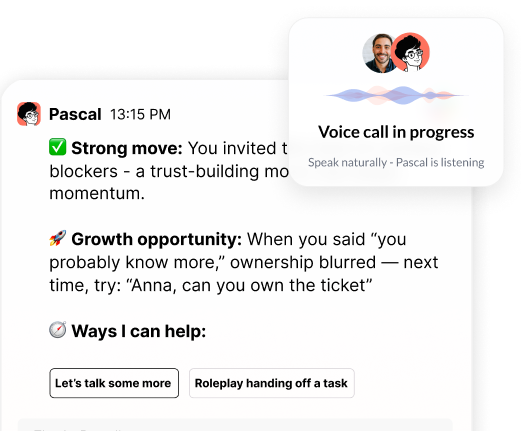
Pascal delivers proactive, personalized coaching that lives where your managers work—in Slack, Teams, and meetings.
See how Pascal works inside Slack
Header photo by Bluestonex on Unsplash

.png)
.webp)
“Thank you for setting the great foundation for my promotion; now I have a plan!"

Curious to see how AI Coaching can 10X the impact and scale of your development initiatives. Book a demo today for: