

AI coaching delivers measurable manager improvements within 90 days (higher adoption, faster skill development, early behavior changes), with full ROI appearing over 6–12 months as sustained behavior change drives retention, performance consistency, and reduced HR costs.
AI coaching matches human coaching effectiveness for routine manager development at 1% of the cost. Traditional one-on-one coaching remains superior for executive-level strategy and sensitive interpersonal situations. The key difference: scalability. AI coaching provides 24/7 access to every manager in your organization. Traditional coaching reaches only 5–10% of leaders because of cost constraints.
Traditional executive coaching costs $3,000–$15,000 per person annually. AI coaching platforms cost $30–$150 per user per year. That's not incremental savings—it's a business model shift that makes coaching economically viable for your entire management population.
Availability matters more than cost. Human coaches schedule sessions weeks in advance, forcing managers to remember context and reconstruct situations from memory. AI coaches provide real-time guidance when managers face decisions (during difficult conversations, before performance reviews, when delegation goes wrong).
Consistency separates purpose-built AI coaching from both human coaches and generic AI tools. Human coaching quality varies by coach expertise and personal chemistry. Purpose-built AI coaching delivers consistent, evidence-based frameworks across all users.
Organizations can extend AI coaching to 100% of managers versus the typical 5–10% who receive traditional coaching. That democratization transforms coaching from an executive perk into an organizational capability. When every manager has access to coaching, you build consistent leadership practices across the company rather than isolated pockets of excellence.
Integration into existing workflows (Slack, Teams, Zoom) eliminates the context-switching that kills adoption in traditional coaching. Managers don't schedule separate sessions or explain situations from scratch. The AI coach already knows their team, their goals, and their recent interactions.
AI coaching will not replace human HR expertise in sensitive situations, immediately solve deep cultural or systemic organizational issues, or deliver overnight transformation without sustained organizational commitment. Setting realistic expectations prevents disappointment and ensures you measure the right outcomes.
Don't expect AI coaching to handle clinical mental health issues or therapy-level interventions. Purpose-built platforms include escalation protocols that route sensitive topics to qualified human professionals. AI coaching supports professional development, not clinical counseling.
Don't expect immediate cultural transformation. AI coaching accelerates behavior change, but shifting organizational culture requires sustained effort across multiple systems (hiring, promotion, rewards, leadership modeling). Coaching is one lever, not a complete solution.
Don't expect 100% adoption in the first month. Building new habits takes time. Organizations with strong change management see 60–75% adoption within 90 days. Those without communication, leadership endorsement, and integration into existing processes struggle to reach 30%.
Don't expect AI coaching to compensate for broken processes. If your performance review system is punitive rather than developmental, coaching won't fix it. If your promotion criteria reward individual contribution over people development, coaching won't change behavior. Fix the system, then use coaching to accelerate the right behaviors.
Don't expect perfect accuracy from day one. Purpose-built platforms improve through usage as they learn your organization's context, culture, and language. Early guidance is good. Sustained usage makes it great.
Adoption metrics reveal whether your investment will pay off. Expect 60–75% of managers actively using the platform weekly, compared to 15–25% for typical learning management systems. That difference isn't marginal—it's the gap between a tool people actually use and another forgotten login credential.
Engagement depth matters more than surface-level logins. Look for an average of 8–12 coaching interactions per user per month, with 40–50% returning within 48 hours. These patterns indicate managers are building habits, not just completing compliance checkboxes.
Learning acceleration shows up in how quickly managers apply new skills. Purpose-built AI coaching enables managers to implement feedback techniques, delegation frameworks, and difficult conversation strategies faster than traditional workshop-based training. The difference comes from in-context coaching at the moment of need rather than abstract classroom scenarios.
Early behavior indicators emerge before financial metrics. Measurable improvements in feedback quality, delegation consistency, and meeting effectiveness appear within the first quarter. These early signs of improvement predict the long-term financial results that justify your investment.
Manager confidence improves measurably. Expect increases in manager satisfaction scores as leaders feel better equipped to handle challenges. Confident managers make better decisions, retain their teams, and develop their people more effectively.
Time savings compound across your organization. Managers save hours through real-time guidance versus researching solutions independently or waiting for scheduled training sessions. That time redirects from problem-solving to actual leadership.
The sustained business impact of AI coaching materializes through reduced manager turnover, faster new manager ramp time, higher quality performance conversations, and decreased HR support burden. Organizations typically achieve full ROI within 12–18 months. These outcomes compound over time as improved manager effectiveness drives team performance, engagement, and retention.
Retention improvement shows up first in manager turnover rates. Organizations see reductions in manager departures as leaders feel better supported and more confident. Replacing a manager costs 100–150% of their annual salary when you factor in recruiting, onboarding, lost productivity, and team disruption.
Ramp time acceleration transforms how quickly new managers become effective. New managers reach proficiency faster with continuous coaching versus quarterly training programs. Instead of struggling through their first year, they build confidence and capability within months.
Performance review quality improves across the organization. More consistent, actionable feedback becomes the norm as managers practice difficult conversations and receive real-time guidance on framing feedback. This consistency reduces legal risk and increases the developmental value of performance discussions.
HR efficiency gains free your team to focus on strategic work. When managers can access coaching for common challenges (delegation, feedback, performance conversations), your HR team handles fewer repetitive questions.
Team engagement rises as manager effectiveness increases. Direct report engagement scores improve measurably when managers receive ongoing coaching support. Better managers create better team experiences, which drives retention and performance at the team level.
Succession readiness improves through behavioral data and development tracking. Better identification of high-potential managers emerges from observing who actively develops their skills, applies coaching insights, and demonstrates consistent growth. This data supplements traditional performance reviews with behavioral evidence.
Purpose-built AI coaching platforms deliver higher sustained engagement and measurably better behavior change compared to generic AI chatbots or custom GPT implementations because they integrate organizational context, observe actual workplace interactions, and provide proactive guidance rather than waiting to be asked. Generic tools provide surface-level advice. Purpose-built solutions drive lasting behavior change.
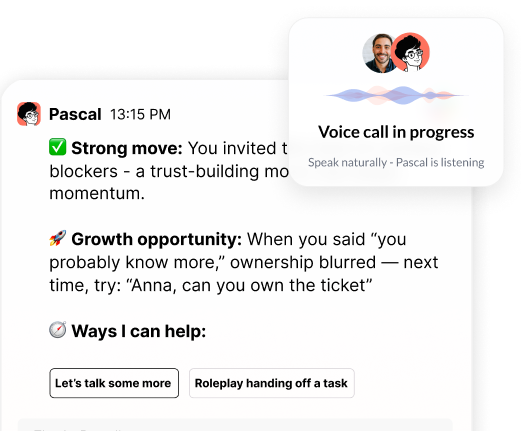
Here's what that looks like in practice: Sarah, a new manager, is about to give critical feedback to an underperforming team member. She opens Slack and asks Pascal, "How do I tell him his work isn't meeting standards without crushing his confidence?" Pascal responds with a specific framework tailored to her team's context, her previous conversations with this employee, and her organization's feedback culture. A generic chatbot would provide abstract advice without knowing Sarah, her team member, or their history.
Contextual awareness separates effective coaching from generic advice. Purpose-built platforms (like Pascal) understand your organization's culture, goals, and individual manager challenges. Generic tools start from zero context every conversation, forcing managers to re-explain situations repeatedly.
Proactive engagement changes the coaching dynamic entirely. Pascal joins meetings and provides real-time feedback. Chatbots wait passively for users to initiate conversations, missing the moments when guidance matters most.
Behavioral observation enables personalized development. Purpose-built solutions analyze actual workplace interactions to identify patterns (how managers delegate, give feedback, run meetings). Generic tools rely entirely on user self-reporting, which introduces bias and limits developmental insights.
Integration depth drives adoption. Purpose-built platforms embed into Slack, Teams, Zoom, and calendar workflows. Generic tools require separate logins and context-switching, creating friction that kills sustained usage.
Safety and compliance protect your organization. Purpose-built solutions include moderation, sensitive topic escalation to human experts, and SOC 2 compliance. Generic tools lack organizational guardrails, creating risk when managers discuss sensitive employee situations.
Measure AI coaching success through leading indicators (engagement depth, repeat usage, manager confidence), behavioral outcomes (feedback quality, delegation consistency, meeting effectiveness), and lagging business metrics (retention, promotion readiness, team engagement), not just platform logins. This multi-layered approach proves ROI and identifies where coaching drives the most value.
Engagement depth reveals whether managers are building habits or completing compliance tasks. Track conversation length, topic diversity, and time between interactions. Managers who return within 48 hours and explore multiple coaching topics are developing skills, not checking boxes.
Behavioral outcomes show actual skill development. Measure feedback quality through direct report surveys, delegation consistency through team productivity metrics, and meeting effectiveness through participant feedback. These indicators predict business outcomes before they appear in retention or engagement data.
Manager confidence surveys provide early signals. Track satisfaction scores for managers, self-reported confidence in handling difficult situations, and willingness to tackle challenging conversations. Confident managers take on more developmental responsibilities.
Team-level metrics connect manager development to business outcomes. Monitor direct report engagement scores, team retention rates, and performance consistency. Improvements in these areas prove that better managers create better team experiences.
Organizational efficiency gains demonstrate scalability. Track HR business partner support requests, time-to-proficiency for new managers, and quality of performance documentation. These metrics show how AI coaching reduces organizational friction.
We help organizations implement measurement frameworks that prove ROI and identify optimization opportunities. See how Pascal works inside Slack to deliver measurable coaching outcomes.
• AI coaching delivers measurable results within 90 days: Expect 60–75% adoption, faster skill development, and early behavior change indicators, with full ROI materializing over 6–12 months
• Purpose-built solutions outperform generic AI tools: Contextual awareness, proactive engagement, and behavioral observation drive sustained usage and actual behavior change
• Business outcomes compound over time: Manager retention improvement, faster new manager ramp time, and reduced HR support requests
• Set realistic expectations: AI coaching accelerates development but doesn't replace human expertise for sensitive situations or solve systemic organizational issues overnight
• Measure beyond adoption: Track engagement depth, behavioral outcomes, and business metrics to prove ROI and optimize your coaching investment
Header photo by Vitaly Gariev on Unsplash

.png)
.webp)
“Thank you for setting the great foundation for my promotion; now I have a plan!"

Curious to see how AI Coaching can 10X the impact and scale of your development initiatives. Book a demo today for: