
AI coaching delivers measurable returns within 90 days when implemented correctly, but the outcomes depend entirely on selecting a purpose-built solution with contextual awareness and proactive engagement. Organizations should expect concrete improvements in adoption, learning speed, and early behavior change—not full financial ROI, which typically materializes over 6–12 months.
Quick Takeaway: Organizations implementing AI coaching see an average return of $3.50 for every $1 invested, often within 90 days. Success depends on five factors: foundational coaching expertise, contextual awareness, proactive engagement, workflow integration, and appropriate guardrails for sensitive topics. These criteria directly determine whether managers adopt the tool and whether adoption drives measurable behavior change.
The pressure to prove ROI on HR programs has never been higher. CHROs face a fundamental challenge: traditional learning and development investments take months to show impact, yet boards want results now. AI coaching changes this timeline. Organizations implementing purpose-built AI coaching platforms are seeing measurable returns within the first quarter, not the first year.
The first 30 days reveal whether your platform will drive sustained engagement or become another underutilized tool. Target 60% weekly active users by week four and 90%+ satisfaction scores.
Engagement frequency matters more than total registered users. Managers should interact 2–4 times per week with the coaching platform to build consistent habits. Session quality indicates depth of engagement; average sessions of 10–20 minutes suggest managers are using the tool for substantive challenges rather than just exploring features. Time to first value should be under 48 hours—managers should receive actionable insights within two days of first use. According to The Conference Board research, 90%+ of users report the coaching feels tailored to their situation.
Platforms integrated into Slack, Teams, or Zoom see dramatically higher adoption because they eliminate friction. Pascal maintains 94% monthly retention with 2.3 sessions per week because managers access coaching without context-switching. The integration removes the barrier that kills adoption in standalone apps—no separate login, no additional tool to remember, just coaching available where work happens.
Structured learning completion accelerates 25–35% faster with AI coaching versus traditional e-learning, and measured competency attainment improves 1.3–1.6× faster. Course completion rates typically rise from low double digits to 40–60%.
Research on AI coaching versus traditional management training shows that feedback quality improves measurably within 60 days. Managers give more specific, actionable feedback because they practice delivery through roleplay before actual conversations. Delegation confidence increases as managers work through delegation scenarios with real team context. One-on-one effectiveness improves when direct reports notice managers come more prepared to career conversations. Most importantly, behavior change sustains—40–60% of participants maintain new habits at 3–6 months post-intervention.
The acceleration comes from immediacy. When a manager practices giving feedback through roleplay before an actual conversation, muscle memory forms faster than waiting for quarterly training. This principle of learning in the flow of work transforms how quickly skill development happens. Rather than attending a workshop and hoping to remember concepts weeks later, managers apply frameworks immediately while context is fresh.
Organizations report 6–12% productivity gains and 15–25% improvement in manager confidence within the first quarter. For sales teams, quota attainment lifts 10–18% when coaching targets high-frequency activities.
Recent research on AI coaching outcomes documents that manager Net Promoter Score increases by an average 20% among highly engaged users. Direct report feedback shows 83% of colleagues report measurable improvement in their manager's effectiveness. Time savings emerge quickly—managers reclaim 3–5 hours monthly previously spent searching for guidance or preparing for difficult conversations. Team engagement improves as managers become more intentional in their one-on-ones and feedback delivery.
These outcomes surface because the coaching targets moments that matter. Rather than generic training on feedback principles, Pascal helps managers prepare for specific feedback conversations with specific employees. Instead of abstract delegation frameworks, the AI coach helps managers practice delegating actual work to actual team members. This specificity is what drives the behavior change that translates into measurable business impact.
Five critical factors determine success: purpose-built coaching expertise (not generic AI), contextual awareness of your people and culture, proactive engagement, workflow integration, and proper guardrails for sensitive topics.
Foundational expertise matters. Purpose-built platforms grounded in people science (like Pascal, trained by ICF-certified coaches) provide guidance managers trust and apply. Generic tools like ChatGPT offer broad answers but lack the depth for nuanced leadership situations. When a manager asks how to handle an underperforming team member, generic AI provides textbook advice. Purpose-built coaching understands that the answer depends on that specific employee's tenure, communication style, performance history, and the team's current dynamics.
Context eliminates friction. When AI knows your people's goals, performance history, and communication styles, managers don't waste time re-explaining situations. This drives sustained engagement. Pascal integrates with your HRIS, performance management system, and communication tools to build rich individual profiles. A manager can ask for help preparing a feedback conversation, and Pascal already knows the employee involved—their role, recent performance, career aspirations, and how they've responded to feedback in the past.
Proactive engagement creates habits. Systems that surface opportunities after meetings rather than waiting for questions drive 2–3× faster skill development. Pascal joins meetings, observes team dynamics, and delivers feedback immediately afterward. This proactive approach creates consistent practice that builds lasting habits. Managers develop skills through repetition and reinforcement rather than one-time training events.
Workflow integration determines adoption. Solutions meeting managers in Slack, Teams, or Zoom see dramatically higher usage than standalone apps. The best coaching happens closest to the triggering event, when context is fresh and motivation is high. Organizations like HubSpot and Zapier have found that embedding AI into existing workflows drives adoption faster than any communication campaign.
Guardrails protect organizations. Proper escalation for sensitive topics (terminations, harassment, medical issues) ensures human expertise gets involved when it matters most. Pascal includes moderation layers that detect toxic behavior, escalation protocols for sensitive employee topics, and organization-specific controls you define. These protections de-risk AI adoption by preventing managers from making legally problematic decisions based solely on AI guidance.
Move quickly through pilots (one to two months), measure leading indicators weekly, and surface early wins to build momentum. Organizations that treat AI coaching as a change management initiative rather than a technology deployment see dramatically better outcomes.
Days 1–30: Focus on access and communication. Get every manager full platform capabilities and explain why this matters to business strategy, not just efficiency. Communicate the "why" clearly—how does better manager effectiveness connect to organizational priorities? Which business outcomes matter most to your company? Frame AI coaching as support that makes managers' jobs easier, not surveillance that monitors their performance.
Days 30–60: Track leading indicators weekly. Measure adoption frequency, session quality, and user satisfaction. Adjust communication if adoption falls below targets. When 60% of managers aren't engaging weekly, that signals a communication problem, integration issue, or value proposition that isn't resonating. Don't wait until day 90 to discover adoption problems. Weekly measurement lets you course-correct quickly.
Days 60–90: Surface early wins and prepare to scale. Document productivity gains and behavior changes even before full financial ROI materializes. Share stories from managers who successfully navigated difficult conversations or improved their delegation approach. These proof points build momentum for broader rollout and justify continued investment.
Jeff Diana's blueprint for AI transformation outlines how CHROs can lead adoption by establishing clear business objectives, managing internal communication strategically, and measuring both leading and lagging indicators. HubSpot, Zapier, and Marriott's approach demonstrates culture-first implementation at scale, focusing on building trust and demonstrating value rather than pushing adoption through mandates.
Full financial ROI typically materializes over 6–12 months, but trajectory metrics become visible in the first quarter. Organizations see $3.50 return per dollar invested on average, with some reporting returns as high as 221% within the first year.
In the first 90 days, focus on leading indicators that predict financial returns. Productivity gains from time savings show up immediately—managers spending 3–5 fewer hours monthly on management questions frees capacity for strategic work. Learning acceleration reduces training costs by 25–40% when AI coaching increases course completion rates and speeds competency development. Early behavioral improvements in feedback quality and delegation directly correlate with improved retention and team performance, which drive long-term financial impact.
The organizations capturing fastest ROI move quickly through pilots, measure weekly, and communicate transparently about what's working. They treat the first 90 days as a learning period where they refine implementation based on real usage patterns rather than expecting perfection immediately.
Ready to see measurable results in your first 90 days? Pascal combines purpose-built coaching expertise, deep contextual awareness of your people and organization, proactive engagement that meets managers in Slack or Teams, and sophisticated guardrails for sensitive topics. The platform delivers the adoption metrics, learning acceleration, and behavior change that predict long-term ROI. Book a demo to see how Pascal drives measurable improvements in manager effectiveness within your first quarter and understand what results your organization should realistically expect.

.png)
.webp)
“Thank you for setting the great foundation for my promotion; now I have a plan!"

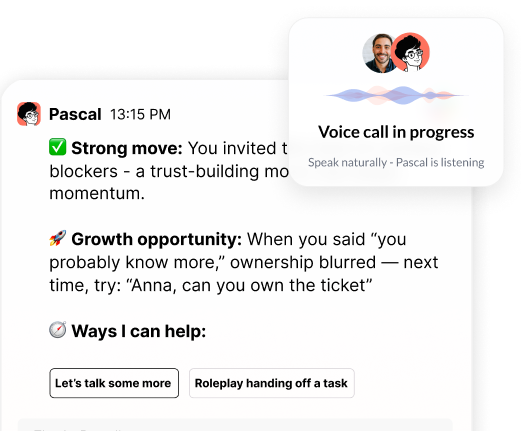
Curious to see how AI Coaching can 10X the impact and scale of your development initiatives. Book a demo today for: