

Digital coaching delivers measurable ROI only when it's placed where coaching is treated as a strategic lever—typically HR/Talent with tight integration to IT, analytics, and business units. The "right" home depends on whether your primary goal is talent development, performance management, or transformation.
Quick Takeaway: Where your digital coach lives in the organization determines adoption rates, governance rigor, and whether coaching becomes a core talent lever or a standalone tool. The most successful implementations place ownership in HR/Talent with co-governance from IT, analytics, and business units—creating the strategic alignment that drives sustained behavior change.
Digital coaching—AI- or platform-enabled coaching solutions—delivers value when owned by a function that can drive strategy, measure outcomes, and integrate coaching into daily workflows. Placement determines adoption rates, governance rigor, and whether coaching becomes a core talent lever or a standalone tool.
Digital coaching is now embedded in 78% of organizations' engagement and retention strategies. Virtual and AI-powered coaching sessions have grown 40% since 2020, with 56% of coaches now using AI tools to track progress and personalize feedback. The online coaching platforms market is projected to grow at 13–14% CAGR through 2034, driven by AI integration and data analytics that make coaching scalable for the first time.
But growth in deployment doesn't guarantee impact. We've seen organizations spend hundreds of thousands on digital coaching platforms only to watch adoption stall because the tool lived in the wrong organizational home. The difference between success and failure often comes down to a single question: who owns this capability, and are they accountable for outcomes?
The best placement depends on your primary outcome: talent development, performance management, transformation, governance, or a hybrid model combining ownership. Each home creates different incentives, measurement approaches, and integration patterns.
Coaching directly impacts engagement, retention, and leadership pipelines—all HR accountabilities. 38% of business coaches already work directly with HR teams for ongoing leadership and performance training. This alignment exists because HR owns the talent strategies that coaching reinforces.
When digital coaching sits in HR/Talent, the function can drive strategy around who gets coached, when, and toward what outcomes. HR can integrate coaching into onboarding, leadership programs, internal mobility, and succession planning. Most importantly, HR can measure coaching impact against business metrics like retention, promotion readiness, and engagement scores.
Pascal exemplifies this integration by working seamlessly with HR systems. The platform connects to HRIS data, performance reviews, and career development plans, allowing HR to personalize coaching at scale while maintaining the governance and measurement rigor this strategic placement requires.
Best fit: Leadership programs, manager development, internal mobility, succession planning, and inclusive development initiatives.
Coaching is being woven into "career-driven learning strategies" integrated with talent systems for ROI tracking. L&D ownership makes sense when coaching reinforces specific capabilities and supports structured learning journeys.
When L&D owns digital coaching, the function can tightly integrate coaching with LMS/LXP platforms, ensuring coaching reinforces training content and extends learning into daily work. This placement works well for organizations building skills academies or role-based development pathways where coaching becomes a standard component rather than a separate intervention.
Best fit: Skills academies, leadership pathways, role-based journeys, and training reinforcement.
AI platforms "leverage data analytics to personalise the coaching journey, assist with goal tracking, and generate actionable insights." Buyers expect proof and analytics linking behavioral shifts to KPIs. Analytics ownership ensures coaching impact gets measured rigorously and connected to business outcomes.
When analytics co-owns digital coaching, the function can establish measurement frameworks, track leading indicators like coaching engagement and behavior change, and connect coaching activity to lagging indicators like performance improvement and retention. This partnership creates accountability for outcomes rather than just activity.
Best fit: Measuring coaching impact on performance, attrition, promotion readiness; integrating with OKR/performance systems; and building the business case for continued investment.
Digital coaching requires enterprise-grade security, data protection, and compliance, especially under the EU AI Act, which entered into force in 2024. Integration with HRIS, collaboration tools, and productivity suites demands technical oversight that IT must provide.
When IT co-governs digital coaching, the organization can establish data governance frameworks, manage model risk, ensure compliance with regulations, and maintain security SLAs. This partnership is essential when coaching platforms access sensitive employee data and need to integrate across multiple enterprise systems.
Best fit: Data governance, model risk, compliance, workflow integration, security SLAs, and enterprise-grade infrastructure.
Coaching is increasingly positioned as part of corporate transformation, sustaining behavior change during change programs. Direct line-of-business ownership aligns accountability with outcomes when coaching is the primary lever for transformation success.
When a business unit owns digital coaching for a specific transformation, the function can target coaching toward the behaviors and capabilities the transformation requires. This ownership creates urgency and clear success metrics tied to transformation outcomes rather than general talent development.
Best fit: Major transformation initiatives (agile at scale, culture change, digital transformation) where coaching is a critical adoption lever.
The most successful digital coaching deployments operate as a trifecta: CHRO (strategy and people), Chief Product Officer (user experience and adoption), and CTO (data, security, integration). "The trifecta is the CHRO, the Chief Product Officer, and the CTO—those three together can reshape how an organization operates," according to Gail Fierstein, former CHRO at CaaStle, Goldman Sachs, and Pearson.
This coalition balances people strategy, user adoption, and technical execution in ways siloed ownership cannot. The CHRO ensures coaching aligns with talent strategy. The CPO ensures the platform drives adoption through seamless user experience. The CTO ensures data security, integration, and compliance. When these three functions align, digital coaching scales effectively.
Choose where coaching sits based on five factors: strategic accountability for outcomes, data integration capability, change management capacity, governance rigor, and workflow integration.
Accountability: Who owns manager effectiveness, retention, or transformation outcomes? Place coaching ownership there.
Data access: Can the function integrate with HRIS, performance systems, and communication tools? Digital coaching requires rich data sources to personalize effectively.
Change leadership: Does the function have credibility to drive adoption and behavior change? Coaching only works when people engage consistently.
Governance: Can they establish guardrails for sensitive topics and ensure compliance? Coaching touches sensitive areas like performance management and difficult conversations that require proper oversight.
Workflow: Can they embed coaching into daily tools (Slack, Teams, Zoom) rather than create new destinations? Adoption depends on meeting people where they already work.
Digital coaching fails when placed in isolated functions without cross-functional partnership, when it lacks clear business metrics, or when it's treated as a standalone tool rather than integrated into talent systems.
Standalone coaching programs—not connected to performance, learning, or succession—see adoption rates below 30%. Extended pilots (6+ months) lose momentum with both early adopters and skeptical majorities. Ownership without executive sponsorship fails to drive the cultural change required for sustained use.
The worst mistake is treating digital coaching as an HR technology purchase rather than a strategic talent capability. When ownership is unclear, measurement is absent, and integration is minimal, coaching becomes another underutilized tool that drains budget without delivering outcomes.
Start with your primary business problem. Is it manager effectiveness? Talent retention? Transformation speed? Your answer determines the right home.
Manager effectiveness or leadership pipeline? Place ownership in HR/Talent or L&D, where coaching can be embedded into development programs and measured against manager quality metrics.
Performance consistency and measurement? Co-own with People Analytics, ensuring coaching impact gets tracked rigorously and connected to business outcomes.
Transformation at scale? House in Business Unit or Transformation Office with HR as partner, creating direct accountability for adoption and behavior change.
Enterprise integration and security? Partner with IT/Data, establishing governance and compliance frameworks that enable safe, scalable deployment.
Organizations like HubSpot, Zapier, and Marriott demonstrate what happens when placement aligns with strategy. They've embedded AI coaching into employee lifecycles, from onboarding through promotion, creating consistent development experiences that drive measurable improvements in manager effectiveness and team performance.
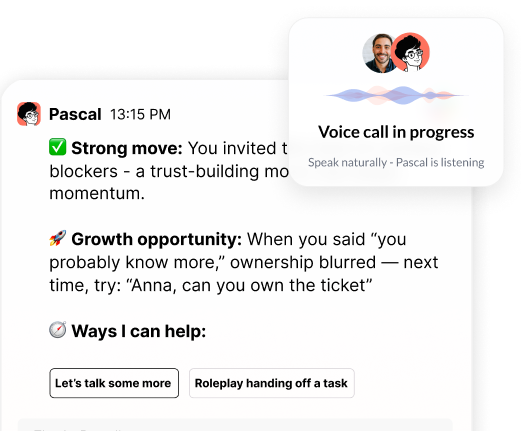
Pascal lives where work happens—Slack, Teams, Zoom—and integrates with your HRIS and performance systems, making it easy to place ownership with HR while ensuring IT and analytics stay connected. The platform's contextual awareness means coaching personalizes to each manager's situation, their team's dynamics, and your organization's culture. Book a demo to explore the right placement strategy for your team and see how Pascal drives manager effectiveness across your organization.

.png)
.webp)
“Thank you for setting the great foundation for my promotion; now I have a plan!"

Curious to see how AI Coaching can 10X the impact and scale of your development initiatives. Book a demo today for: