

An AI coach should live where managers already work—embedded in Slack, Teams, and Zoom—not in a standalone portal they need to remember to visit. The most effective placement combines HR ownership for strategy and governance with seamless integration into daily workflow tools, ensuring coaching happens in real-time when managers need it most.
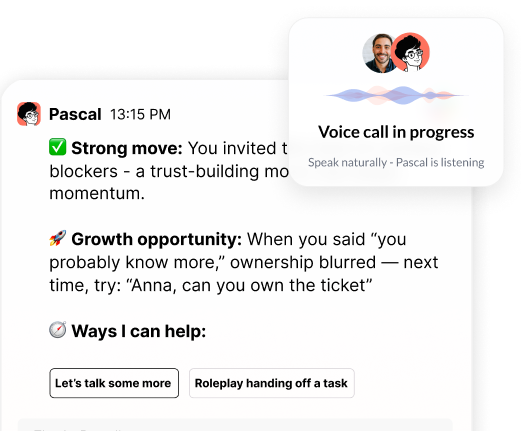
Embedding an AI coach means integrating it directly into the communication and collaboration tools managers use every day—Slack, Microsoft Teams, Zoom, and Google Meet—rather than requiring them to log into a separate platform. Pascal by Pinnacle exemplifies this approach by joining meetings, sitting in messaging channels, and providing real-time guidance in the flow of work, achieving 83% observable improvement rates from direct reports.
Workflow integration eliminates adoption friction. Managers don't need to remember to visit another tool or carve out dedicated time for coaching. Real-time context drives relevance—an AI coach that observes actual meetings and conversations can provide specific, actionable feedback immediately after interactions. Proactive engagement creates habits rather than waiting for managers to ask questions.
According to research from The Edge of Work, AI coaching tools that integrate into existing workflows show 3-5x higher sustained engagement compared to standalone portals. At Delta Airlines, managers using embedded AI coaching reduced performance review prep time from 60 minutes to 10 minutes while improving feedback quality.
Comparison of Embedded vs. Standalone AI Coaching Platforms
Data Breakdown:
• Factor: Adoption rate | Embedded in Workflow: 70-85% sustained | Standalone Portal: 15-30% after 90 days
• Factor: Time to value | Embedded in Workflow: Immediate | Standalone Portal: 2-4 weeks
• Factor: Context awareness | Embedded in Workflow: Real-time signals | Standalone Portal: Self-reported only
• Factor: Manager effort | Embedded in Workflow: Minimal | Standalone Portal: Requires dedicated time
The difference between a coaching system that becomes a daily resource and one that collects digital dust comes down to whether managers encounter it naturally or need to remember it exists. 24/7 availability meets managers where they are—coaching becomes accessible in the moment of need, not just during scheduled sessions.
HR should own the AI coaching platform strategically while partnering closely with IT for technical integration and business unit leaders for adoption. This ownership model ensures coaching aligns with talent development objectives, maintains appropriate governance for sensitive workplace topics, and integrates seamlessly into existing technology infrastructure.
HR ownership ensures strategic alignment. Talent development, performance management, and cultural transformation goals drive platform configuration and rollout priorities. IT partnership enables technical integration—seamless connections to Slack, Teams, Zoom, HRIS systems, and performance management platforms require IT collaboration. Business unit buy-in drives adoption—functional leaders like CTOs, VPs of Sales, and Operations Directors must champion the tool within their teams for sustained engagement.
Melinda Wolfe, former CHRO at Bloomberg, Pearson, and GLG, emphasizes: "If we have an innovation right now, it's incumbent upon us as HR leaders to show our companies an economic and effective way to help managers." This requires HR to own the vision while building coalitions across functions.
Cross-functional governance protects employees. HR, Legal, and IT collaboration establishes guardrails for data privacy, sensitive topic escalation, and compliance. Pascal's SOC2 compliance and built-in escalation protocols for sensitive topics demonstrate how purpose-built AI coaching platforms support this governance model. The platform never trains on customer data and includes moderation flags that alert HR when conversations require human expertise.
HR should own the platform while embedding access directly within team workflows—this hybrid approach combines strategic oversight with practical adoption. HR maintains governance, configures organizational competencies, and tracks aggregate outcomes, while team leaders and managers access coaching through their existing tools without HR gatekeeping every interaction.
HR ownership without HR bottlenecks means managers get immediate coaching support without waiting for HRBP availability, freeing HR capacity for complex issues. Consistent guidance across teams ensures all managers receive coaching aligned with organizational values and competencies. Team-level customization within guardrails allows departmental leaders to add function-specific context while maintaining company-wide standards.
According to research on AI coaching adoption, frontline and mid-level managers show the highest engagement, particularly during transitions like first-time management roles or promotions. These populations benefit most when coaching is immediately accessible in their daily work rather than requiring HR intermediation.
Jeff Diana, former CHRO at Calendly, Atlassian, and SuccessFactors, notes: "There's never been a better time for HR leaders to harness change and shape how AI transforms work—not wait for others to decide it for us." This means HR must architect the system while ensuring managers experience it as seamlessly integrated into their workflow.
Aggregate insights inform strategy. HR sees enterprise-level patterns in skill gaps and cultural alignment without accessing individual conversations. This protects employee privacy while providing the data HR needs to refine talent development programs.
Essential integrations include communication platforms (Slack, Microsoft Teams), meeting tools (Zoom, Google Meet), HRIS systems for organizational context, and performance management platforms for goal alignment. Pascal's "Plugged-in" architecture demonstrates this approach by connecting across the entire tech stack to pull real-time signals and deliver contextual guidance.
Communication platform integration enables real-time coaching. Managers receive guidance in Slack or Teams immediately after challenging conversations or before important meetings. Meeting observation provides behavioral context—AI coaches that join Zoom or Google Meet calls can offer specific feedback on communication patterns, meeting facilitation, and team dynamics.
HRIS integration personalizes guidance. Access to role, tenure, team structure, and organizational hierarchy allows coaching to adapt to each manager's specific context. Performance management connection aligns development—integration with goal-setting and review systems ensures coaching reinforces the behaviors that matter most to your organization.
At HubSpot, 98% of employees had used an AI tool on the job and 84% felt comfortable doing so, driven by integration into existing workflows rather than adoption of new standalone tools. The key is making AI coaching feel like a natural extension of how work already happens, not an additional system to learn.
An AI coach should live in daily tools—Slack, Teams, and meeting platforms—not buried inside your LMS. Learning management systems are designed for structured content delivery, not real-time behavioral coaching. Managers need guidance in the moment of decision, not when they remember to log into a training portal.
The distinction matters for adoption. LMS platforms see engagement rates of 10-20% after the initial rollout period. Tools embedded in daily workflow maintain 70-85% sustained engagement. The difference comes down to friction—every additional click, login, or context switch reduces the likelihood managers will seek coaching when they need it.
Purpose-built AI coaching platforms like Pascal sit where conversations happen. When a manager faces a difficult feedback conversation, the coach is already in the Slack channel. When a meeting goes off track, the coach observed it and can provide immediate guidance. This immediacy transforms coaching from a periodic activity into a continuous development process.
Small L&D teams particularly benefit from this approach. By embedding AI coaching in workflow tools, lean teams can scale their impact without proportionally increasing staff. The AI handles day-to-day guidance while L&D focuses on strategic initiatives and complex cases that require human expertise.
Centralized governance with decentralized access means HR sets the framework—organizational competencies, cultural values, escalation protocols—while every manager gets immediate coaching without approval workflows. This model scales coaching across the organization while maintaining consistency and safety.
HR configures the foundation. They define what "good management" looks like at your company, upload relevant documentation, and establish guardrails for sensitive topics. They track aggregate metrics to understand skill gaps and measure program effectiveness. But they don't sit between managers and coaching.
Managers access coaching directly. When they need help preparing for a performance conversation, they ask the AI coach in Slack. When they're unsure how to handle a team conflict, they get guidance immediately. No tickets, no waiting, no bottlenecks.
This approach addresses the capacity challenge most HR teams face. Traditional coaching models require HR to be involved in every interaction. AI coaching frees HR to focus on strategic work—designing competency frameworks, analyzing trends, handling complex cases—while managers get support for routine challenges.
The guardrails protect everyone. When conversations touch on sensitive topics—harassment, discrimination, mental health—the AI escalates to human HR professionals. This ensures appropriate expertise is involved when it matters most while allowing the AI to handle the vast majority of coaching interactions safely.
Sustained adoption rates above 70%, measurable behavior change observed by direct reports, and reduced HR ticket volume for routine management questions indicate your AI coach is properly positioned. These metrics prove the platform is accessible, trusted, and driving real outcomes.
Adoption metrics come first. If usage drops below 30% after 90 days, your coach isn't embedded where managers work. Track weekly active users, messages sent, and meeting participation. Pascal customers maintain 94% monthly retention because the coach lives in tools managers already use daily.
Behavior change metrics prove impact. Survey direct reports on whether they've observed improvements in their manager's communication, feedback quality, and leadership effectiveness. At organizations using embedded AI coaching, 83% of direct reports report observable improvements in their manager's effectiveness.
Efficiency metrics demonstrate ROI. Track time saved on performance reviews, reduction in HR tickets for routine management questions, and faster resolution of team conflicts. Delta Airlines saw performance review prep time drop from 60 minutes to 10 minutes—a 6x efficiency gain.
Leading indicators matter too. Monitor how quickly managers engage with coaching after challenging situations, how often they proactively seek guidance before important conversations, and whether they're applying coaching recommendations in subsequent interactions. These behaviors predict long-term development.
• Embed your AI coach in Slack, Teams, and Zoom where managers already work—standalone portals see 15-30% adoption while embedded tools maintain 70-85% sustained engagement
• HR should own the platform strategically while ensuring managers access coaching directly without approval workflows, combining governance with immediate availability
• Essential integrations include communication platforms, meeting tools, HRIS systems, and performance management platforms to provide real-time context and personalized guidance
• Purpose-built AI coaching platforms outperform LMS-based solutions because they deliver guidance in the moment of need, not when managers remember to seek training
• Track adoption rates, behavior change observed by direct reports, and reduced HR ticket volume to validate your AI coach is properly positioned within your organization
Pascal by Pinnacle joins your meetings, sits in your messaging channels, and provides real-time coaching where your managers already work. See how embedding AI coaching in your workflow drives measurable behavior change.
Header photo by Vitaly Gariev on Unsplash

.png)
.webp)
“Thank you for setting the great foundation for my promotion; now I have a plan!"

Curious to see how AI Coaching can 10X the impact and scale of your development initiatives. Book a demo today for: