

AI coaches embedded in Slack, Teams, and meetings drive 3–5x higher adoption than standalone portals. According to Conference Board research, embedded tools maintain 75% regular usage versus 15–25% for standalone platforms. Placement determines whether your investment transforms manager effectiveness or becomes expensive shelfware.
Embedding means your AI coach lives inside the tools managers already use—Slack, Microsoft Teams, Zoom, Google Meet—and proactively engages at moments when coaching matters most. True embedding includes three layers: technical integration (API connections to communication platforms), contextual awareness (observing meetings and reading organizational signals), and proactive engagement (reaching out with feedback after a 1:1, not waiting to be asked).
Technical integration connects directly to Slack, Teams, Zoom, and Meet through APIs—not just SSO login to another app. Contextual awareness means the coach observes actual work: meetings, communication patterns, team dynamics. Proactive engagement flips the script: the coach initiates conversations based on observed moments ("I noticed you delegated that project—want to debrief?") instead of waiting for managers to remember to ask.
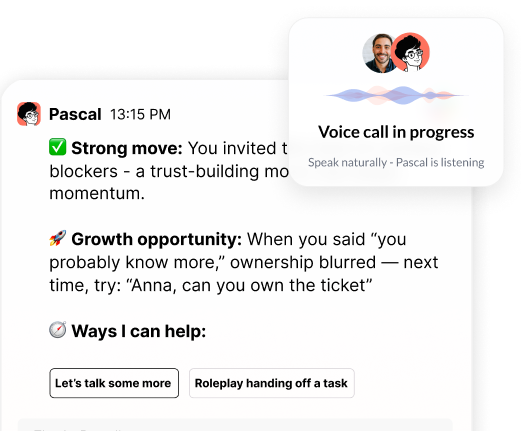
Standalone portals require managers to context-switch, re-explain situations, and remember to use the tool. Pascal lives in Slack and Teams, joins meetings as an observer, and delivers feedback within minutes of leadership moments. This reduces friction from "I need to go find help" to "help finds me when I need it."
Placement impacts the two factors that predict sustained usage: friction to access and relevance of guidance. When coaching sits in a separate portal, managers must remember the tool exists, open a browser, find their login, navigate the interface, explain context, receive advice, then return to work. When embedded in Slack or Teams, managers receive a proactive message.
Conference Board research shows embedded AI coaching maintains 75% regular usage versus 15–25% for standalone tools. Daily tools like Slack and Teams create 10–15 touchpoints per day for active users. Separate portals average 0.3 visits per week. Habit formation requires frequency, and embedded coaches can observe and initiate while standalone tools wait passively.
Based on Pascal customer data across 50+ deployments:
Data Breakdown:
• Integration Model: Standalone Portal | Avg. Monthly Active Users: 15–25% | Time to First Value: 2–3 weeks | Sustained Engagement (6 months): 10–15%
• Integration Model: Embedded (Slack/Teams) | Avg. Monthly Active Users: 70–85% | Time to First Value: 24–48 hours | Sustained Engagement (6 months): 65–75%
• Integration Model: Meeting-Integrated | Avg. Monthly Active Users: 80–90% | Time to First Value: First meeting | Sustained Engagement (6 months): 75–85%
In Pascal deployments, 83% of managers report direct report improvement when coaching is embedded, compared to generic training completion rates of 12–18%. The difference isn't the content—it's the delivery mechanism.
Integrate directly into existing workflows—Slack, Teams, and meeting platforms—because managers won't adopt another tool they must remember to use. Jeff Diana, former CHRO at Calendly and Atlassian, emphasizes that "so much of the real learning and value comes from in-context coaching in the moment to drive performance and solve problems in the moment."
The adoption curve reality: standalone tools see 60–70% first-week usage, dropping to 10–15% by month three. Workflow integration points include Slack and Teams for daily coaching, Zoom and Meet for meeting observation, and calendar for proactive check-ins. Embedded coaches already know the context; standalone tools require managers to re-explain situations.
Integration with existing HR tech amplifies impact. Connect to HRIS (Human Resources Information System, like Workday or BambooHR) for performance data and goals, LMS (Learning Management System) for training completion, and engagement surveys for team sentiment. Pascal plugs into Slack, Teams, Zoom, Meet, plus HRIS and performance management systems for full context.
Highly regulated industries (healthcare, financial services) may require separate, auditable systems initially. Companies like Ripple start with standalone Pascal for regulatory reasons, then add meeting integration as compliance frameworks mature.
AI coaching succeeds when it sits at the intersection of Learning & Development and HR Business Partners (HRBPs), with executive sponsorship from the CHRO. This placement connects coaching to both skill-building programs and real-time manager challenges.
L&D owns the competency frameworks, leadership development curricula, and training programs that coaching reinforces. HRBPs understand the manager challenges, team dynamics, and performance issues where coaching delivers immediate value. The CHRO provides the strategic mandate and resources to scale.
Successful deployments identify champions who share their successes, provide early access to team members before full rollout, and have senior leaders use and endorse the tool. Connect Pascal to organizational rituals: quarterly check-ins, performance reviews, goal-setting sessions.
Avoid placing AI coaching solely within IT (becomes a technology project without business context) or solely within L&D (disconnects from real-time manager needs). The sweet spot is shared ownership with clear accountability metrics: adoption rates, engagement frequency, and behavioral outcomes.
Track three categories: adoption (who's using it and how often), engagement (depth of usage and sustained habits), and outcomes (measurable behavior change and business impact). Adoption without engagement means managers tried it once. Engagement without outcomes means they're using it but not changing behavior.
Adoption metrics include monthly active users (target: 70%+), time to first interaction (target: under 48 hours), and percentage of managers using coaching weekly (target: 60%+). These numbers reveal whether placement eliminates friction.
Engagement metrics include average interactions per manager per week (target: 3+), conversation depth (multi-turn dialogues versus one-off questions), and proactive engagement acceptance rate (when the coach reaches out, managers respond). Conference Board research shows embedded coaches maintain 75% engagement versus 15–25% for standalone tools.
Outcome metrics include manager NPS improvement (Pascal customers see 20% increases), direct report feedback on manager effectiveness, and time saved on routine coaching queries (150+ hours for L&D teams). Leading indicators matter: increased 1:1 frequency, higher-quality feedback conversations, and faster performance review completion.
If your metrics show high adoption but low engagement, your placement succeeded but your content or UX needs work. If you see low adoption, placement is the problem—the coach sits too far from daily workflows.
The biggest mistake is treating AI coaching as a standalone tool that managers access when they remember to use it. Managers are overwhelmed and context-switching constantly. If coaching requires conscious effort to access, it won't become a habit.
The second mistake is integrating with too many systems at once without clear use cases. Connecting to HRIS, LMS, performance management, engagement surveys, and calendar sounds comprehensive, but if managers don't understand why the coach needs that data, it feels invasive. Start with meeting integration and Slack/Teams, then add data sources as value becomes clear.
The third mistake is launching without executive sponsorship and champion identification. As HR leaders from HubSpot, Zapier, and Marriott shared, AI adoption requires visible leadership endorsement and peer proof points. Managers need to see their VP using the coach before they'll trust it.
The fourth mistake is measuring the wrong things. Tracking "number of coaching sessions" misses the point. What matters is sustained behavior change: Are managers giving better feedback? Delegating more effectively? Having higher-quality 1:1s? Outcome metrics reveal whether placement drives impact.
• Embedded AI coaches drive 3–5x higher adoption than standalone portals by eliminating the "remembering to use it" problem and delivering coaching in the flow of work.
• Placement determines outcomes: AI coaching integrated into Slack, Teams, and meetings maintains 75% engagement versus 15–25% for separate portals, according to Conference Board research.
• Context creates specificity: Embedded coaches that observe actual meetings deliver behavioral feedback ("You interrupted Sarah three times") versus generic advice ("Practice active listening").
• Organizational home matters: AI coaching succeeds at the intersection of L&D and HRBPs, with CHRO sponsorship connecting skill-building to real-time manager challenges.
• Measure adoption, engagement, and outcomes: Track monthly active users, interaction frequency, and measurable behavior change—not just "number of coaching sessions."
The placement question isn't theoretical. It's the difference between transforming manager effectiveness and adding another underutilized tool to your stack. See how Pascal works inside Slack to deliver coaching where work happens.
Header photo by Chase Chappell on Unsplash

.png)
.webp)
“Thank you for setting the great foundation for my promotion; now I have a plan!"

Curious to see how AI Coaching can 10X the impact and scale of your development initiatives. Book a demo today for: