
AI coaching delivers measurable impact only when embedded in managers' daily workflows (Slack, Teams, Zoom), not isolated in standalone portals. Embedding determines whether your investment becomes a trusted daily habit or another underutilized tool.
Embedded AI coaching lives inside the tools managers already use. It proactively engages based on real work context, not waiting in a separate portal for managers to remember it exists.
The Conference Board identifies embedding "in the flow of work" as AI coaching's "potentially transformative benefit." Standalone portals require managers to context-switch, re-explain situations, and remember to visit. That friction kills adoption.
Embedding operates across four dimensions:
• Technical integration: Native presence in communication platforms
• Contextual awareness: Access to meeting transcripts, communication patterns, organizational data (goals, competencies, values)
• Proactive engagement: Initiates coaching moments based on observed behavior
• Workflow alignment: Connects to existing HR rituals (performance reviews, goal-setting, 1-on-1s)
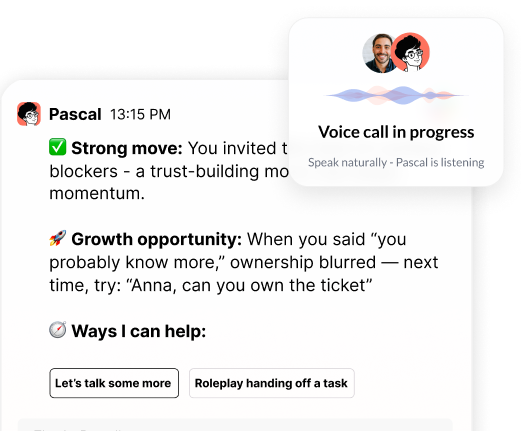
Here's what this looks like in practice: A manager interrupts a direct report three times in a standup. The AI coach observes the meeting transcript, identifies the pattern, and sends a Slack message within minutes: "I noticed you cut off Sarah three times when she was explaining the API delay. This might signal urgency to you, but it reads as dismissiveness to your team. Try this in your next 1-on-1: 'Sarah, I interrupted you earlier. Walk me through what's blocking the API work.'" The coach doesn't wait for the manager to open a portal and describe what happened. It saw what happened and delivered guidance at the moment it mattered.
Pascal joins meetings, sits in Slack and Teams, and pulls real-time signals across your tech stack. This depth of integration separates tools that change behavior from those that collect dust.
Embedding directly in workflow tools eliminates the cognitive load of context-switching. When coaching requires opening a separate app and explaining the situation from scratch, usage drops to 10-20% within three months.
Standalone tools create four barriers:
The context tax forces managers to re-explain team dynamics and recent conversations every time they seek guidance. Remembering friction requires active recall to visit a separate tool during high-pressure moments. Workflow interruption breaks managers out of their natural work rhythm. Generic guidance without real context feels theoretical, eroding trust.
Embedded coaching delivers measurable advantages:
Pascal's proactive approach joins meetings, observes communication patterns, and initiates coaching at the right moments. Zero context-switching means coaching happens in Slack and Teams where managers already spend 6+ hours daily. Real-time relevance ties guidance to specific meetings and conversations managers just experienced. Habit formation accelerates because daily presence builds muscle memory faster than periodic portal visits.
Internal data from Pascal customers shows managers save 150+ hours annually when coaching is embedded versus standalone. 83% of direct reports observe measurable improvement in manager effectiveness with embedded tools versus 15-25% with portals. (These figures come from Pascal customer surveys, not independent research. We're working with academic partners to validate these findings in controlled studies.)
Your AI coach should sit organizationally within HR and Talent Development with tight integration partnerships with IT. This placement ensures coaching aligns with competency frameworks, performance processes, and culture while leveraging IT's technical infrastructure.
Data Breakdown:
• Placement: HR/Talent (Recommended) | Advantages: Aligns with competencies, performance cycles, culture; clear accountability for manager development | Risks: Requires IT partnership for technical integration | Best For: Organizations prioritizing manager effectiveness and cultural transformation
• Placement: IT/Digital Transformation | Advantages: Fast technical deployment, strong security governance | Risks: Disconnected from people strategy; coaching becomes a "tool" not a development lever | Best For: Tech-first companies with mature IT-HR partnerships
• Placement: Standalone/Decentralized | Advantages: Individual teams customize usage | Risks: No organizational alignment; inconsistent adoption; difficult to measure impact | Best For: Not recommended for enterprise deployment
How to choose: If your organization struggles with inconsistent manager quality and you have executive sponsorship from your Chief People Officer, HR ownership works. If your IT team drives digital transformation and has a strong partnership with HR, IT ownership can work. If neither function has clear ownership of manager development, fix that problem before deploying AI coaching.
HR ownership works because HR owns the competency frameworks, values, and cultural priorities that coaching must reinforce. (Competency frameworks are the specific skills and behaviors your organization expects from managers—things like "gives clear feedback" or "delegates effectively.") IT provides technical infrastructure, security compliance, and integration architecture. Business units provide use case validation and adoption champions.
Critical success factors:
Identify an executive sponsor in HR (typically the Chief People Officer or VP Talent Development). Establish IT partnership for Slack and Teams integration, single sign-on, and data governance. Connect coaching to existing HR rituals: quarterly check-ins, performance reviews, goal-setting cycles. Create a cross-functional steering committee with HR, IT, and business unit leaders.
Pascal deploys through HR, integrates technically through IT, and customizes with organizational competencies and values. This ensures coaching reinforces the behaviors that matter to your culture.
Successful embedding requires native integration with communication platforms, real-time data access across your tech stack, and enterprise-grade security that protects sensitive workplace conversations.
Core technical requirements:
Native platform presence means the coach operates directly within Slack, Teams, and Zoom (not through external links or separate logins). Real-time data pipelines connect to HRIS, performance management systems, and goal-tracking tools to maintain current context. API-first architecture enables custom workflows and integrations with your existing people processes. (This means you can connect the AI coach to your existing tools without rebuilding your tech stack.) Enterprise security includes SOC2 compliance (an auditing standard that verifies we protect your data), data encryption, and clear policies that customer data never trains AI models.
Pascal maintains native presence across communication tools, pulls real-time signals from your tech stack, and operates under SOC2 compliance with strict data protection.
Integration depth matters:
Surface-level integrations that link to external portals fail to reduce context-switching. Deep integrations that observe meetings, understand communication patterns, and connect to organizational data drive sustained engagement. The technical architecture directly impacts whether managers trust and adopt the coaching.
Embedding success shows up in three outcomes: sustained daily adoption rates above 60%, direct report feedback indicating manager behavior change, and reduced time spent on performance conversations while improving quality.
Leading indicators:
Daily active usage above 60% after three months indicates the tool has become a habit. Session frequency of 3-5 interactions per week shows managers turn to coaching proactively. Time-to-value under two weeks means managers see immediate benefit without lengthy onboarding.
Lagging indicators:
Direct report surveys showing 80%+ observe manager improvement validate that coaching translates to behavior change. Manager NPS increases of 15-20 points demonstrate sustained satisfaction. (NPS, or Net Promoter Score, measures how likely managers are to recommend the tool to peers.) Time savings of 100+ hours annually per manager prove efficiency gains alongside quality improvements.
Pascal customers report these metrics consistently, though we acknowledge these come from our customer base, not independent research. We're partnering with organizational psychology researchers at Stanford and Wharton to validate these findings in controlled studies launching in Q2 2025.
• Embedding location determines adoption: AI coaching embedded in Slack, Teams, and Zoom drives higher sustained usage than standalone portals because it eliminates context-switching and meets managers where they work.
• Organizational placement matters: HR ownership with IT partnership ensures coaching aligns with competencies, culture, and performance processes while maintaining technical excellence and security compliance.
• Technical depth drives trust: Native platform integration, real-time data access, and enterprise security separate tools that change behavior from those that create new workflow friction.
• Measure what matters: Track daily adoption above 60%, direct report feedback on manager improvement, and time savings alongside quality gains (not just pilot enthusiasm or feature usage).
The question isn't whether to adopt AI coaching. It's where to embed it for maximum impact. Organizations that integrate coaching into daily workflows (with clear HR ownership, technical excellence, and measurable outcomes) transform manager effectiveness at scale. Those that treat it as another standalone tool watch adoption collapse within months.
Header photo by Austin Distel on Unsplash

.png)
.webp)
“Thank you for setting the great foundation for my promotion; now I have a plan!"

Curious to see how AI Coaching can 10X the impact and scale of your development initiatives. Book a demo today for: