

First-time managers and distributed teams see the fastest returns from AI coaching because they face frequent, high-stakes decisions without access to immediate support. Traditional coaching happens in scheduled sessions. AI coaching happens during actual work—when a manager prepares for a difficult conversation, handles a team conflict, or navigates a customer escalation.
A Fortune analysis found that 70% of team engagement variance traces back to the manager. Yet most managers get development only during workshops or annual reviews—far removed from the moments when they actually need help.
Research from CEB (now Gartner) shows that 60% of new managers fail within their first 24 months. The primary reason: lack of support during critical transitions. They attend onboarding, take notes, then face real challenges alone.
Traditional coaching costs $3,000–$10,000 per person annually and requires scheduling across time zones. AI coaching costs $50–$200 and works 24/7. This explains the 156% year-over-year adoption increase in 2023 (Careertrainer.ai).
But cost and availability don't matter if the coaching doesn't work. The question is whether AI can provide useful guidance for the ambiguous, context-specific situations managers face.
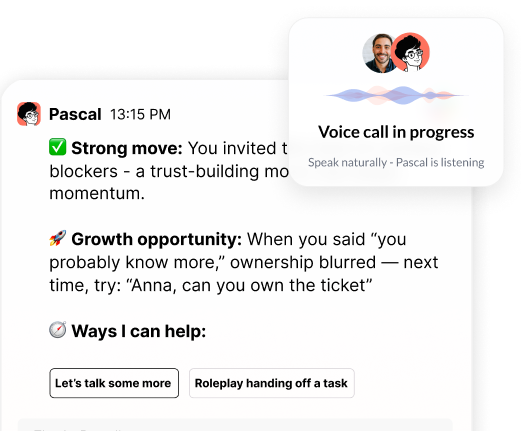
AI coaching platforms embed in Slack, Teams, and Zoom. A manager types a question before a performance review. The system provides a framework: how to structure the conversation, what questions to ask, how to balance feedback with development goals.
The guidance draws from two sources: proven management frameworks (like situational leadership or radical candor) and patterns from successful managers in the organization. When a sales manager asks how to handle a specific objection, the system references both general negotiation principles and approaches that worked for top performers in similar situations.
This isn't a chatbot providing generic advice. The system learns company culture, team dynamics, and individual manager challenges over time. A manager who consistently asks about delegation receives increasingly specific guidance tailored to their team structure and workload.
The limitation: AI coaching works for situations with established best practices. It helps managers apply proven frameworks to their specific context. It doesn't replace human judgment for novel situations without precedent.
First-time managers see the fastest impact because they make dozens of people decisions weekly without established frameworks to guide them. New managers make decisions about how to delegate a project, whether to escalate a performance issue, and how to balance team requests with business priorities. Each decision is a learning opportunity.
Traditional coaching provides feedback days or weeks after a conversation happened. AI coaching offers frameworks before the conversation—when guidance can actually shape the outcome.
Consider a first-time manager preparing for their first difficult performance conversation. They open Slack and ask: "How do I tell someone their work isn't meeting expectations without destroying their confidence?" The system provides a structure: start with specific examples, explain the impact, ask for their perspective, agree on next steps together.
The manager uses this framework in the conversation. It goes better than expected. They return to the system afterward to reflect on what worked. This cycle repeats across dozens of interactions each month.
The volume creates compound effects. A manager who improves their approach to one-on-ones by 10% touches that skill 50+ times per year. Small improvements across frequent interactions add up to measurable performance gains.
First-time managers also benefit from the private nature of AI coaching. Many hesitate to ask questions that might make them appear incompetent to senior leaders. The system provides a judgment-free space to explore challenges before taking action.
Melinda Wolfe, former CHRO at Bloomberg and Pearson, notes: "When it comes to helping first-time or mid-level managers, the risk of doing nothing can be just as high as the risk of trying something new."
Distributed teams show 40% higher engagement rates with AI coaching because time zones make synchronous coaching impractical, and AI provides immediate support when human coaches aren't available. A manager in Singapore can't grab quick advice from a senior leader in New York before an important meeting. The alternative is often no support at all.
Remote teams show engagement rates with AI coaching tools that are 40% higher than office-based teams (measured by weekly active usage). The value proposition becomes immediately clear when the next-best option is waiting three days for guidance or making decisions without support.
Distributed teams also face unique challenges: managing across cultures, leading asynchronous work, building trust without face-to-face interaction. AI coaching provides frameworks for these situations based on practices from successful remote organizations.
A manager leading a team across four time zones asks: "How do I give feedback when I can't have a real-time conversation?" The system suggests asynchronous feedback approaches: written feedback with specific examples, video messages for tone, scheduled follow-up for questions.
The consistency matters too. Every manager receives guidance aligned to company values, whether they work from Singapore, New York, or São Paulo. Geographic equity in development opportunities doesn't depend on physical proximity to headquarters.
Sales and customer-facing roles generate immediate ROI because they have high-frequency, high-stakes interactions where communication improvements directly impact revenue. Sales professionals face customer calls, negotiations, and objections daily—each one a coaching opportunity where better guidance translates to better outcomes.
Traditional training happens quarterly. Deals happen daily. AI coaching tightens the feedback loop from weeks to minutes. A sales representative who receives guidance on handling pricing objections right after a challenging call can apply those insights to the next prospect conversation the same day.
Customer success teams face similar dynamics. A single mishandled interaction can jeopardize accounts worth hundreds of thousands in annual recurring revenue. AI coaching helps teams navigate difficult conversations, manage escalations, and strengthen relationships in real time.
The combination of frequency and immediacy creates compound effects. A customer success manager who improves their approach to quarterly business reviews by 10% touches 40+ client interactions per year. That improvement potentially impacts retention rates across their entire portfolio.
Sales roles also generate abundant data that AI coaching can use. Call recordings, email exchanges, and CRM notes provide context for personalized guidance. The system identifies patterns—a rep consistently struggling with a particular objection type—and provides targeted coaching to address specific skill gaps.
Data Breakdown:
• Role/Group: First-Time Managers | Primary Benefit: Real-time frameworks for high-frequency decisions | Engagement Rate: High (daily use) | Typical ROI Timeline: 4-8 weeks | Cost per Person (Annual): $50-$200
• Role/Group: Distributed Teams | Primary Benefit: 24/7 access across time zones | Engagement Rate: 40% higher than office-based | Typical ROI Timeline: 6-12 weeks | Cost per Person (Annual): $50-$200
• Role/Group: Sales Teams | Primary Benefit: Immediate guidance on revenue-impacting conversations | Engagement Rate: Very High (multiple daily uses) | Typical ROI Timeline: 2-4 weeks | Cost per Person (Annual): $100-$200
• Role/Group: Customer Success | Primary Benefit: Escalation management and relationship building | Engagement Rate: High (weekly use) | Typical ROI Timeline: 8-12 weeks | Cost per Person (Annual): $75-$150
• Role/Group: Traditional Human Coaching | Primary Benefit: Deep relationship, complex situations | Engagement Rate: Varies | Typical ROI Timeline: 3-6 months | Cost per Person (Annual): $3,000-$10,000
Companies undergoing rapid growth promote managers faster than they can train them. A technology company that doubles headcount annually might promote 50+ new managers each quarter. Building traditional coaching infrastructure to support that growth would require hiring multiple full-time coaches—an investment that takes months to implement.
AI coaching provides consistent development from day one. New managers access guidance immediately without waiting for the next cohort training program.
Cultural transformation initiatives require changing behaviors across entire organizations. When a company shifts from a hierarchical to a coaching culture, managers need support in adopting new behaviors during actual work situations. AI coaching reinforces desired behaviors in real time, providing feedback aligned to new values.
Leadership transitions create knowledge gaps. When experienced managers leave, their expertise leaves with them. Organizations can build coaching frameworks based on the approaches of their most successful leaders. A departing VP of Sales records their approach to key situations. The system incorporates these insights into guidance for their replacement.
This knowledge capture has limits. Tacit knowledge—the intuition experienced leaders develop over years—doesn't transfer easily to any system, AI or otherwise. But explicit frameworks, decision trees, and situation-specific approaches can be preserved and shared.
AI coaching works for situations with established best practices. It helps managers apply proven frameworks to their specific context. It doesn't replace human judgment for unprecedented situations.
A manager facing a complex ethical dilemma needs human guidance. A leader navigating a sensitive organizational conflict needs a trusted advisor. AI coaching handles the routine 80% of management challenges. The other 20% still requires human coaches.
The system also can't replace the relationship-building that happens in traditional coaching. Some managers need someone who knows their history, understands their goals, and can challenge their thinking over time. AI coaching complements this relationship but doesn't replace it.
Organizations should think of AI coaching as a foundation, not a complete solution. It provides consistent, accessible support for common challenges. Human coaching focuses on complex situations, leadership development, and strategic thinking.
First-time managers and distributed teams see the fastest returns because they face frequent decisions where real-time guidance creates measurable improvements within weeks.
AI coaching costs $50–$200 per person annually versus $3,000–$10,000 for human coaching. This cost difference enables organizations to provide support at scale.
Sales and customer-facing roles benefit from tightened feedback loops—minutes instead of weeks between interaction and coaching—with direct impact on revenue outcomes.
Organizations undergoing growth, transformation, or leadership transitions see accelerated returns because AI coaching scales without adding headcount.
The limitation: AI coaching works for situations with established best practices. Complex ethical dilemmas, unprecedented organizational challenges, and long-term leadership development still require human coaches.
See how Pascal works inside Slack and Teams to deliver real-time coaching for your managers. Learn more at www.heypinnacle.com/product.
Header photo by Marvin Meyer on Unsplash

.png)
.webp)
“Thank you for setting the great foundation for my promotion; now I have a plan!"

Curious to see how AI Coaching can 10X the impact and scale of your development initiatives. Book a demo today for: