

Start with first-time and mid-level managers. They face daily people decisions (performance conversations, delegation, conflict resolution), build habits fastest, and show measurable results in 60–90 days that drive broader adoption.
Your pilot population makes or breaks adoption. First-time and mid-level managers face more people decisions than any other group and need guidance immediately, not in six months when a human coach has availability. When these managers see results in their first 60–90 days, they become your most credible advocates.
New managers encounter 15–20 coachable moments per week—a direct report asks for feedback on a presentation, a team member misses a deadline, two engineers disagree on technical approach. Each interaction is a learning opportunity where real-time guidance compounds. Gallup research shows that 70% of the variance in team engagement correlates with manager quality, yet most managers receive minimal training.
When managers share specific wins ("This helped me navigate a difficult termination conversation"), peers ask for access. Bottom-up demand drives adoption faster than top-down mandates.
Senior leaders have existing support systems (executive coaches, peer networks, direct access to HR). First-time managers are drowning in people decisions with no safety net. They face the steepest learning curve and have the least access to traditional coaching resources.
A new manager handles 3–5x more people decisions than a VP who has built systems and delegated effectively. Frontline managers are also more willing to experiment with AI tools than executives who may view them as "not for people at my level." Managers building habits for the first time adopt new approaches faster than leaders unlearning 15 years of patterns.
The organizational leverage: improving 50 frontline managers impacts 500+ employees. Improving 5 VPs impacts their direct reports but rarely changes day-to-day team dynamics.
Data Breakdown:
• Dimension: Cost per user | Executive Coaching: $15,000–$25,000/year | Mid-Level Manager AI Coaching: $150–$300/year
• Dimension: Scalability | Executive Coaching: Limited to top 5% | Mid-Level Manager AI Coaching: Entire management layer
• Dimension: Frequency of use | Executive Coaching: Bi-weekly sessions | Mid-Level Manager AI Coaching: Daily, in-the-flow
Target high-potentials and willing adopters first. Your pilot needs early wins, and high-performers are more likely to engage consistently, share results, and become champions. Struggling managers often resist new tools ("another thing HR is making me do"). Once you have proof points from high-performers, you can position AI coaching as the resource top managers use—making it aspirational rather than remedial.
Start with 20–30 high-performers, collect testimonials, then expand to broader manager populations with social proof already established. As Melinda Wolfe, former CHRO at Bloomberg, Pearson, and GLG, notes in her conversation with Pinnacle: "When it comes to helping first-time or mid-level managers, the risk of doing nothing can be just as high as the risk of trying something new."
Look for managers who face frequent people decisions, are open to experimentation, and have influence across the organization. Ideal candidates include first-time managers (6–18 months in role), managers of managers who can cascade learnings, department heads in high-growth areas, and managers in distributed teams where real-time coaching access is limited.
Ideal Pilot Participant Characteristics:
• Managers with 3+ direct reports
• Recent promotion to management (within 24 months)
• Willingness to share feedback and experiences
• Influence within their peer group or department
• Geographic distribution (especially remote teams)
• Department diversity (Engineering, Sales, Customer Success)
Launch after performance review cycles when managers are actively seeking development resources, not during peak business periods. Include 2–3 departments to test cross-functional applicability. Engineering, Sales, and Customer Success often show strong early adoption because these functions already use multiple tools and embrace experimentation.
Aim for 50–100 managers minimum. Smaller pilots lack statistical significance. Larger pilots (200+) are difficult to support during onboarding and may dilute your ability to collect detailed feedback. Below 50 users, you don't create enough peer-to-peer momentum. Above 100, you lose the ability to personally onboard and support early adopters.
CHROs and HR business partners should use Pascal for 30 days before launching to managers. This builds credibility ("I use this tool myself") and helps you understand the experience firsthand. You'll discover which use cases resonate most, how to explain the value proposition, and what objections to anticipate.
HR leaders who pilot first also identify integration opportunities with existing programs. You might discover that Pascal works well for preparing managers for difficult conversations or for post-training reinforcement. These insights shape your rollout messaging and help you connect AI coaching to existing initiatives rather than positioning it as "one more thing."
Jeff Diana, former CHRO at SuccessFactors and Calendly, emphasizes in his blueprint for CHROs leading AI transformation that HR leaders must shape how AI transforms work rather than letting other functions make those decisions. Using the tool yourself is the first step in that leadership.
Track adoption metrics first, then leading indicators of behavior change, then business outcomes. In the first 30 days, measure login frequency, session length, and feature usage. By day 60, look for changes in manager behavior: more frequent 1:1s, documented feedback conversations, improved delegation. By day 90, measure team-level outcomes: engagement scores, retention rates, performance review quality.
90-Day Success Metrics:
• Adoption (Days 1–30): 70%+ weekly active users, 3+ sessions per week per manager
• Behavior Change (Days 31–60): 40% increase in documented feedback conversations, 25% increase in 1:1 frequency
• Business Impact (Days 61–90): 15-point increase in manager effectiveness scores, 20% improvement in direct report engagement
The most powerful proof points come from qualitative feedback. Collect specific stories: "Pascal helped me prepare for a termination conversation that went better than expected" or "I used Pascal's delegation framework and my team delivered a project two weeks early." These testimonials drive peer adoption faster than any dashboard.
Organizations that connect AI coaching to existing rituals see faster ROI. Link Pascal usage to quarterly goal-setting, performance reviews, or leadership development programs. When managers see AI coaching as part of their workflow rather than an add-on, adoption becomes habitual.
Identify 3–5 managers in your pilot who naturally share their experiences and ask them to become formal advocates. Give them early access to new features, invite them to feedback sessions, and amplify their stories in company communications.
Effective champions don't just say "this tool is great"—they share specific use cases. "I used Pascal to prepare for a difficult performance conversation with a senior engineer. The role-play feature helped me anticipate objections and stay calm. The conversation went better than any I've had in five years of management." That level of specificity makes peers want access.
Create a Slack channel or Teams space where pilot participants can share wins, ask questions, and troubleshoot together. Peer-to-peer learning accelerates adoption and surfaces use cases you might not have anticipated. The best implementations feel like a movement, not a mandate.
• Start with first-time and mid-level managers who face 15–20 coachable moments per week and have the steepest learning curve
• Prioritize high-performers and willing adopters first to build social proof before expanding to broader populations
• Aim for 50–100 managers in your pilot—large enough for statistical significance, small enough for hands-on support
• HR leaders should use the tool themselves for 30 days before rollout to build credibility and understand the experience
• Measure adoption first (70%+ weekly active users), then behavior change (documented feedback, 1:1 frequency), then business outcomes (engagement, retention)
• Champions who share specific use cases drive peer adoption faster than any HR communication
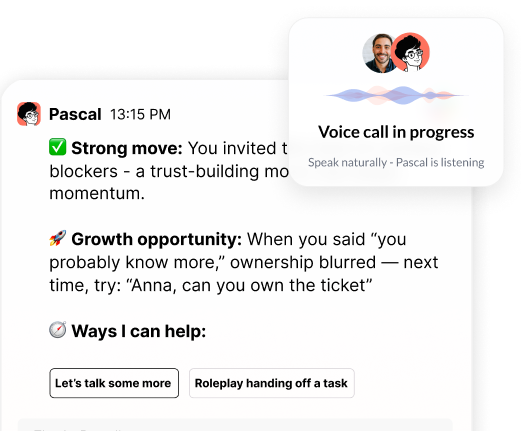
Pascal is the AI coach that lives where work happens—in Slack, Teams, and meetings. It joins your 1:1s, offers real-time feedback, and helps managers navigate difficult conversations with confidence. See how Pascal works.
Header photo by Austin Distel on Unsplash

.png)
.webp)
“Thank you for setting the great foundation for my promotion; now I have a plan!"

Curious to see how AI Coaching can 10X the impact and scale of your development initiatives. Book a demo today for: