Blog article
CHRO relevance is on the line
Just 7% of CEOs see CHROs as AI-savvy. To stay relevant, HR leaders must lead human-AI work design.


Boards are telling CEOs the same thing across almost every industry right now: move faster, tighten accountability, and get ahead of a market that AI is reshaping in real time.
The language in the boardroom is operational: Execution, cost discipline, speed to market. Underneath that operational language sits something harder to name. Asking an organization to execute faster and hold people more accountable is asking people to work differently with each other, day to day, in the actual conversations where decisions get made. That makes this a culture mandate as much as a strategic one.
Why the usual playbook falls short
HR's standard response reaches for a familiar set of tools: a refreshed values deck, an all-hands meeting where the CEO explains the new direction, a classroom training module on the behaviors leadership wants to see, and an annual engagement survey to check whether any of it stuck. The deck names the intent, the meeting
Then everyone crosses their fingers and hopes it landed. The engagement survey is the only feedback loop in that sequence, and it reports back once or twice a year at best, filtered through self-reported bias that rarely captures what's actually happening day to day. When the results come back concerning, the usual fix is another round of focus groups, which eats up everyone's time and still arrives months after the moment it was meant to catch.
But if you ask veteran HR and talent leaders independently what culture actually is, the same answer keeps coming back: it's what people do, not what they say, but none of the traditional tools can show whether behavior actually changed in the room where it matters.
What it looks like when an AI coach sits in the room
While AI is at the core of many disruption, it also enables incredible progress in the world of coaching.
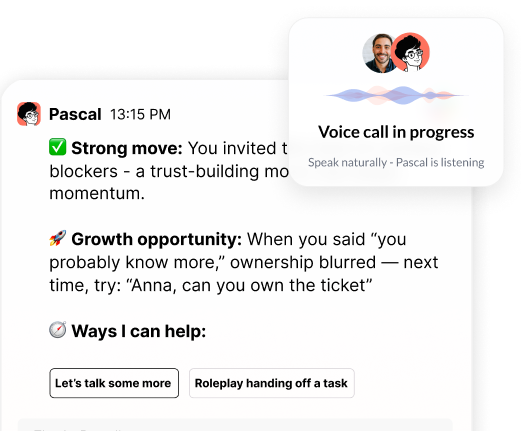
Pinnacle’s customers routinely use Pascal, our AI coach, to join meetings the way a colleague would, with everyone's knowledge and consent. Before rollout, leadership defines what accountability actually means in observable terms: every discussion ends with a named owner, a next step, and a date, and vague follow-up gets flagged the moment it happens.
A VP runs a project review. The conversation is thoughtful, and everyone leaves with a general sense of what to do, but no single sentence assigned ownership, and no date got attached to anything discussed. After the meeting, the AI coach sends the VP a short, specific note: here's the exact line where the conversation drifted from "you own this by Friday" into "we should probably." The VP reads it in Slack in ninety seconds, on the way to the next meeting.
That happens again the next week, and the week after, until the VP starts closing meetings differently. The shift traces back to repeated, private nudges landing right after the moments that mattered, building a habit no single training session had managed to create. It's this manager layer, the people actually running meetings and setting daily tone, where a culture mandate either takes hold or quietly dies on the way down from the boardroom.
The same signal, scaled up
Multiply that VP by every leader in the sales organization, and something else becomes possible. Individual conversations and feedback stay private to the person who had them. Once a group reaches a meaningful size, HR sees an aggregated, anonymized read of the pattern instead: one region closing meetings with clear ownership 80% of the time, another region doing it 30% of the time.
That gap is the moment the CEO's mandate stops being a word in a town hall and becomes a number an HR leader can act on. Instead of waiting for next year's survey to reveal that one region never adopted the new operating rhythm, the gap shows up within weeks, specific enough to warrant a real conversation with that region's leadership rather than another company-wide reminder about the importance of accountability.
Why the coach earns trust instead of losing it
None of this works if it feels like surveillance, and that risk deserves a direct answer rather than a footnote. No individual's transcripts, coaching conversations, or private feedback are ever visible to a manager, to HR, or to anyone but the person who had them, and what rolls up to leadership is only the aggregated pattern, never the person behind it.
The boundary runs deeper than a privacy setting. Coaching a person on their own behavior, privately and for their own benefit, is the point. Giving an organization the ability to ask something like which of my people are underperforming is a different category entirely, one a well-built AI coach should refuse outright, full stop. That distinction is why the tool has to stay visible rather than hidden: a leader can see the AI coach in the meeting, ask what it does, and choose to keep using it, much like people got used to a note-taking tool showing up on calls a few years ago.
The companies that got this right earned adoption by giving their leaders something useful first, a personal coach that caught the moments they meant to be clearer and weren't. That early trust is what let the tool scale into something bigger.
Each private win at the individual level feeds the aggregate picture HR can see, and quickly those individual habits add up to an organizational one: companies that can point to real numbers, region by region, as proof the culture shift the board asked for had actually taken hold.

.png)
.webp)
“Thank you for setting the great foundation for my promotion; now I have a plan!"

Curious to see how AI Coaching can 10X the impact and scale of your development initiatives. Book a demo today for: