Blog article
AI in HR: What CHROs told us at the November roundtable
Key insights from Pinnacle's November CHRO roundtable on what's working in AI enablement and adoption across leading organizations.


In 2025, AI adoption became table stakes. Most organizations now offer access to AI tools, have run pilots, and encourage experimentation across functions. Employees generally know how to use AI responsibly, write a prompt, and apply it to light tasks like summarizing emails.
What has not kept pace is value.
Gartner’s latest HR Leaders Quarterly report, explains why. AI creates impact when organizations redesign work. Section’s own AI Proficiency Report data shows where that redesign is breaking down in practice. Together, they point to the same underlying issue. Adoption has outpaced clarity on how work should change.
Section’s benchmark highlights interesting adoption patterns: engineering, strategy, and business development lead in AI proficiency, yet even these functions score in the low 40s on a 100-point scale. Marketing sits in the middle. Product, operations, and customer support lag significantly, with customer service showing minimal usage and no measurable time savings.
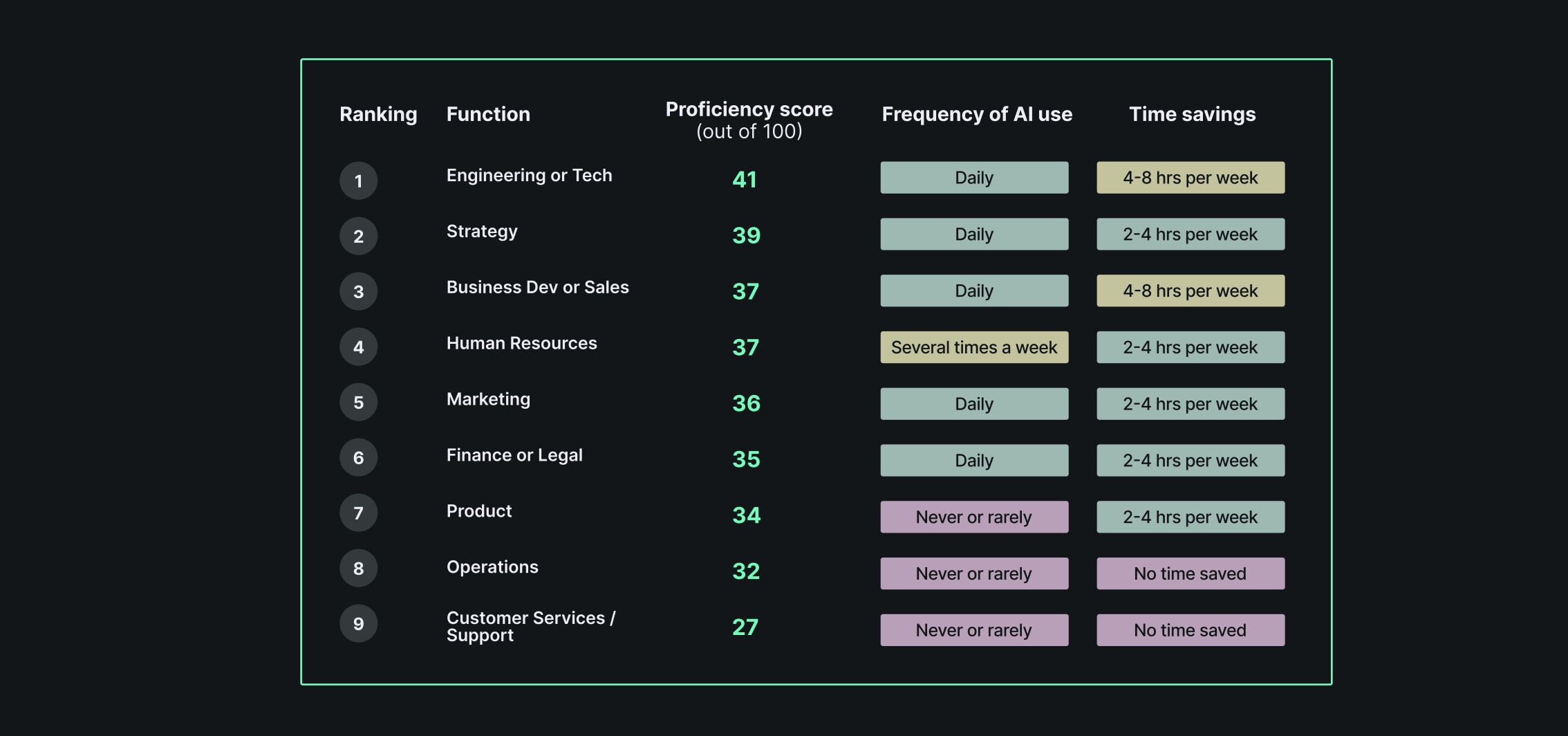
What stands out is how modest the gains remain even among leading functions. Daily usage does not translate into meaningful transformation. Most roles save only a few hours per week at best.
Gartner’s data reinforces this dynamic: business units that redesign how work gets done are twice as likely to exceed revenue goals compared to those that simply deploy AI tools and encourage experimentation.
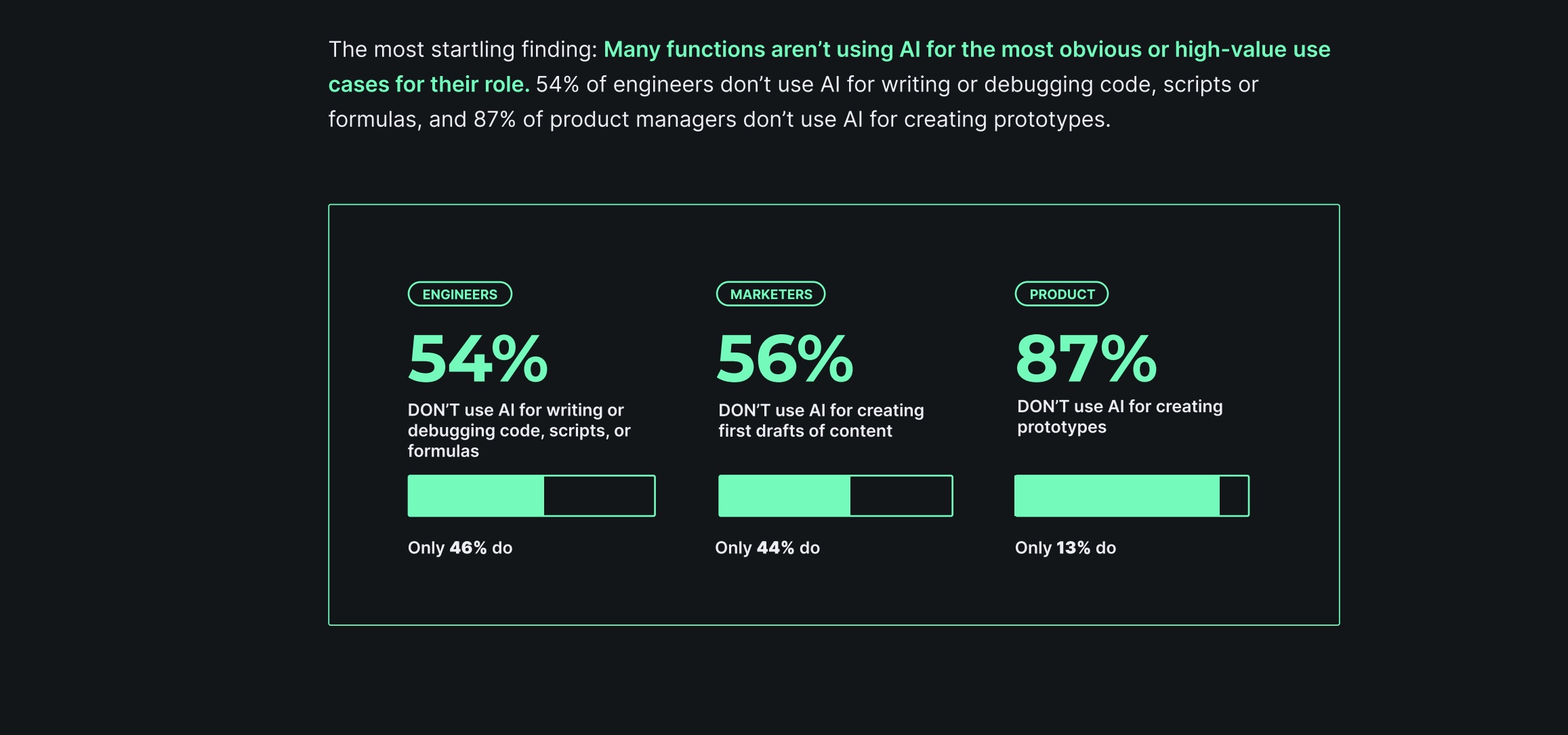
One of Section’s clearest signals appears within leading functions, where everyday AI applications are still unevenly adopted. More than half of engineers do not use AI for writing or debugging code. A majority of marketers do not use AI to create first drafts of content. Nearly nine out of ten product managers do not use AI to create prototypes.
Most employees sit between experimentation and value. They try AI, but struggle to identify the highest-impact opportunities in their workflows.
Gartner identifies three ways organizations are transforming work with AI. Each requires different leadership choices and introduces different risks.
.png)
Augmentation applies AI to existing tasks with the goal of improving speed and accuracy. This is where most organizations begin. Progress depends on whether guidance is available at the moment decisions are made and whether that guidance reflects the realities of the role and the organization.
Teams that see steady gains tend to focus AI use on a defined set of recurring moments, such as preparing for conversations, clarifying priorities, or synthesizing information. Concentrating on these moments helps experimentation translate into consistent improvements in day-to-day work.
Reengineering changes how work moves across roles and teams. At this stage, AI starts to influence operating models and coordination patterns.
Gartner’s research shows that these changes often emerge unevenly across the organization. When redesign efforts proceed without coordination or HR involvement, longer-term effects surface later, including gaps in talent pipelines, reduced entry-level opportunities, and limited internal mobility. Addressing these implications early supports continuity as workflows evolve.
Invention introduces ways of working that were not previously feasible. Agentic workflows offer a clear illustration, with AI taking on a growing share of day-to-day decisions over time.
Near-term progress depends on talent readiness. While large-scale job displacement remains limited, demand is already shifting toward new capabilities. Organizations that provide clear pathways for employees to move into emerging roles are better positioned to support this phase of work transformation.
Taken together, Gartner’s research and Section’s findings point in the same direction: AI value increases when work is clearly defined, supported, and allowed to evolve. This shift places CHROs in a central role. They operate at the intersection of roles, capabilities, and long-term talent health, which makes them uniquely positioned to influence how AI shows up in day-to-day work.

.png)
.webp)
“Thank you for setting the great foundation for my promotion; now I have a plan!"


Curious to see how AI Coaching can 10X the impact and scale of your development initiatives. Book a demo today for: